




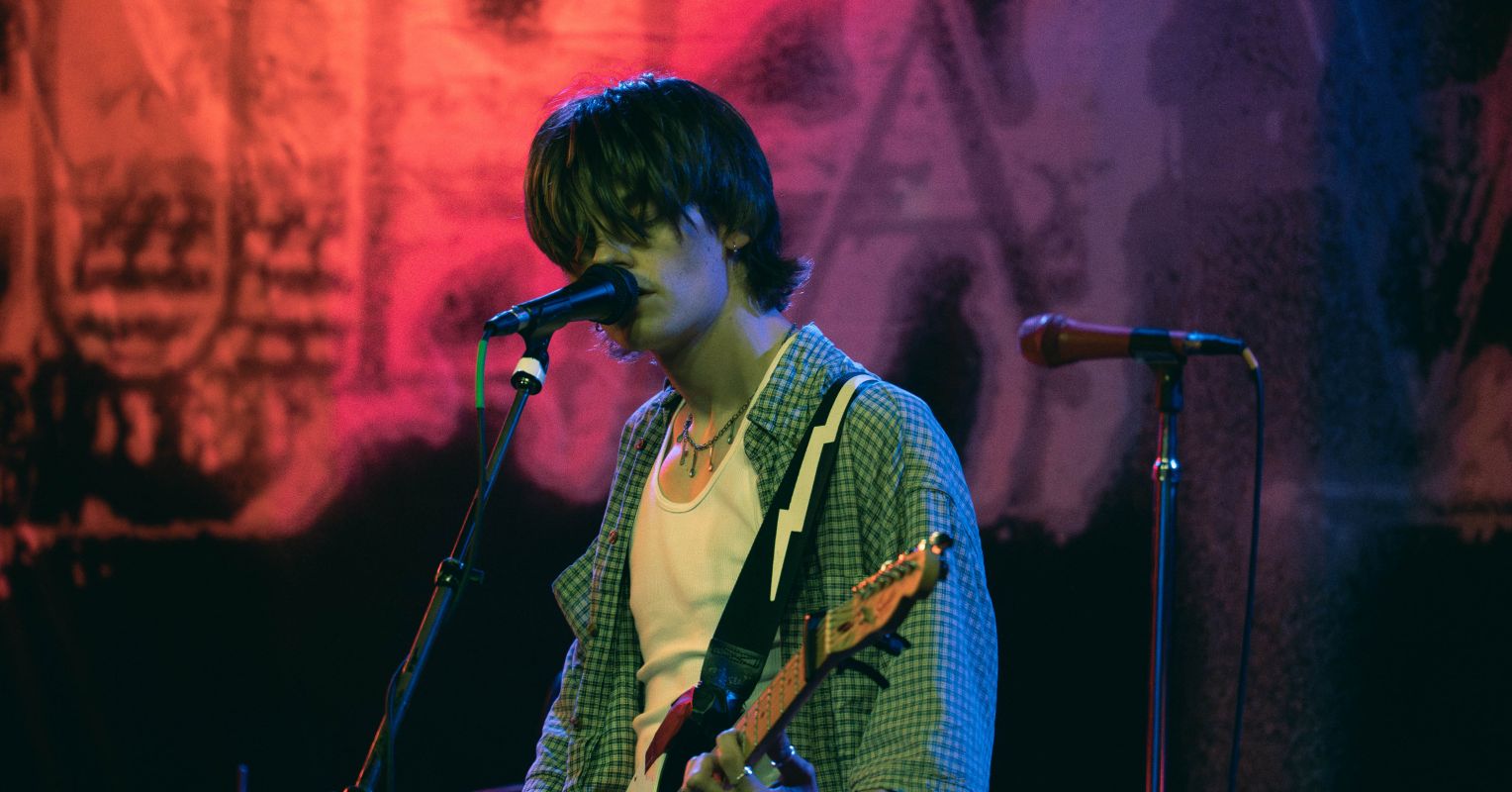
What initially drew me to this band was its name. Worry Club is genius. It is disarming, ironic, and earnest at the same time, like a support group you would want to join.
I had the pleasure of chatting with Chase Walsh, the frontman and creative force behind Worry Club. I wanted to understand the psychology behind that name and the person who chose it. What unfolded was a conversation about vulnerability, masculinity, humor as armor, pushing the body to its edge, and what it means to build identity in public.
“I was wearing a hoodie that said ‘No Worries Club,’” Chase told me, laughing. “I thought that was kind of cringe… and my coworker was like, ‘You should just cross out the no and make it Worries Club.’ And I was like, that’s so perfect. It’s so emo, but also community-driven.”
The shift from No Worries to Worries is more than clever branding. Instead of denying anxiety, it reframes and collectivizes it. In doing so, it becomes more tolerable.
Identity: The Kid With the Guitar
Coming from a musical family, Chase started playing instruments at a very young age.
“I kind of grew up always being that kid who plays instruments. That was kind of my identity.”
Erik Erikson described adolescence as a period of identity versus role confusion, where individuals explore who they are and how they fit into the world (Erikson, 1968). For Chase, music became a stabilizing self-concept that offered continuity and meaning. He played sports, but music was where he felt most anchored, most himself, and most able to express parts of his inner world that were otherwise difficult to articulate.
The Studio Self vs. The Stage Self
Reflecting on his persona of writing alone versus performing live, he said:
“I would say the part of me that writes songs alone versus my live performance persona is quite different… when I write songs with the understanding that people I know will hear them. And I think that’s where humor comes in. Like, when I’m being vulnerable, I feel the need to be funny.”
Humor can be a powerful defense mechanism. It allows individuals to metabolize painful emotions without denying them entirely. It creates just enough distance to stay connected to the self without being overwhelmed by the sense of exposure.
“If I write a really, really sad song, I’m like, well, there has to be a fun angle to it… so nobody asks too many questions.”
Humor also functions as a boundary, allowing Chase to share his vulnerability while still maintaining control over how much access others have to his inner landscape.
Flow is a state of deep immersion where self-consciousness drops and time distorts (Csikszentmihalyi, 1990). For many performers, live music creates that altered state, high risk, high reward, emotionally regulated through rhythm and connection.
Chase noted that he rewrites songs during live shows, often improvising in the moment.
“I can speed up the song if I’m feeling it… or slow it down depending on the crowd’s vibe,” he said.
In many ways, this is multiple nervous systems co-regulating the same space in real time. The band reads the room. The room reads the band. The energy loops.
“I want everyone to have a good time at the shows… including me.”
That “including me” is crucial. So many performers disappear inside the demand to please, losing their own sense of presence in the experience.
Pushing Limits
Currently on the “I’m Freaking Out Tour,” Worry Club is bringing their high-energy live shows across the country as Chase navigates the physical and mental demands of performing.
“I’ve been trying to stay as healthy as possible this tour,” he shared. “Taking time to stretch and warm up is huge to avoid stress and injuries.”
Between long travel days, inconsistent sleep, and the adrenaline of performing, maintaining even small routines to regulate the body, which is constantly being pulled out of its natural rhythm, is essential.
“I think I push the limits of my body pretty much every tour,” he says. “Just to see if I can.”
“Sometimes I’m sick, and we still have to get through the show,” Chase explained. “That’s the hardest part, especially as a singer. You can really damage your voice if you push it too far.”
In performance-based industries, the body becomes both instrument and commodity. The drive to push past fatigue is often reinforced and rewarded, even when it comes at a physiological and psychological cost.
The Male Body
Visibility has reshaped his relationship with his body and presentation. Stage outfits allow bolder choices.
“There’s a separate section in my closet for stage outfits,” he said, “things that maybe I wouldn’t wear in my day-to-day. Like, a tiny shirt or something.”
Traditional masculinity often emphasizes being emotionally guarded, tough, and stoic, while music culture, especially in alternative spaces, can allow more fluidity and expression.
“That’s why I’m not an athlete and instead I’m a musician, you know,” he says.
“I’m a very skinny dude. Never been able to put on any weight or build muscle. So wearing that little shirt, in a way, is showing the real me…it’s very freeing.”
Relatability and the 24/7 Creative Brain
Chase is unusually transparent with fans.
“I’m a barista at home, just like you,” he tells them. “I have to work to pay bills.”
In an era of hyper-curated personas, relatability humanizes the performer and reduces the psychological distance between artist and audience.
Still, the cost of constant visibility can be draining.
“I’m on Worry Club time 24/7,” he admitted. “It’ll be 11:30 at night and I feel like I’m supposed to be productive and start scrutinizing myself.”
The mental load of creative labor in the algorithm age can be exhausting. There is constant pressure to produce, track engagement, and stay relevant. There is no clear boundary between identity and output, and no real off switch.
“Being that fully immersed in my passion is not putting food on the table,” he said. “Trying to juggle surviving and keep making music… that’s been really tough.”
This conflict is familiar to many artists, navigating the pull between creative authenticity and financial survival, between staying true to oneself and adapting to societal demands.
The Club We’re All In
We are performing not only on stages, but across social media, relationships, employment, and everyday life. The pressure to be seen, evaluated, and understood in real time can intensify internal experiences that were once more private. For many, anxiety is a process lived out loud through reels and shared through memes.
As much as this exposure can feel overwhelming, it can also open the door to connection. Through open conversations, naming Mental health concerns, singing it, joking about it, and sweating through it, it becomes possible to create a community around it.
Worry Club does not eliminate worry. It brings it into connection.