




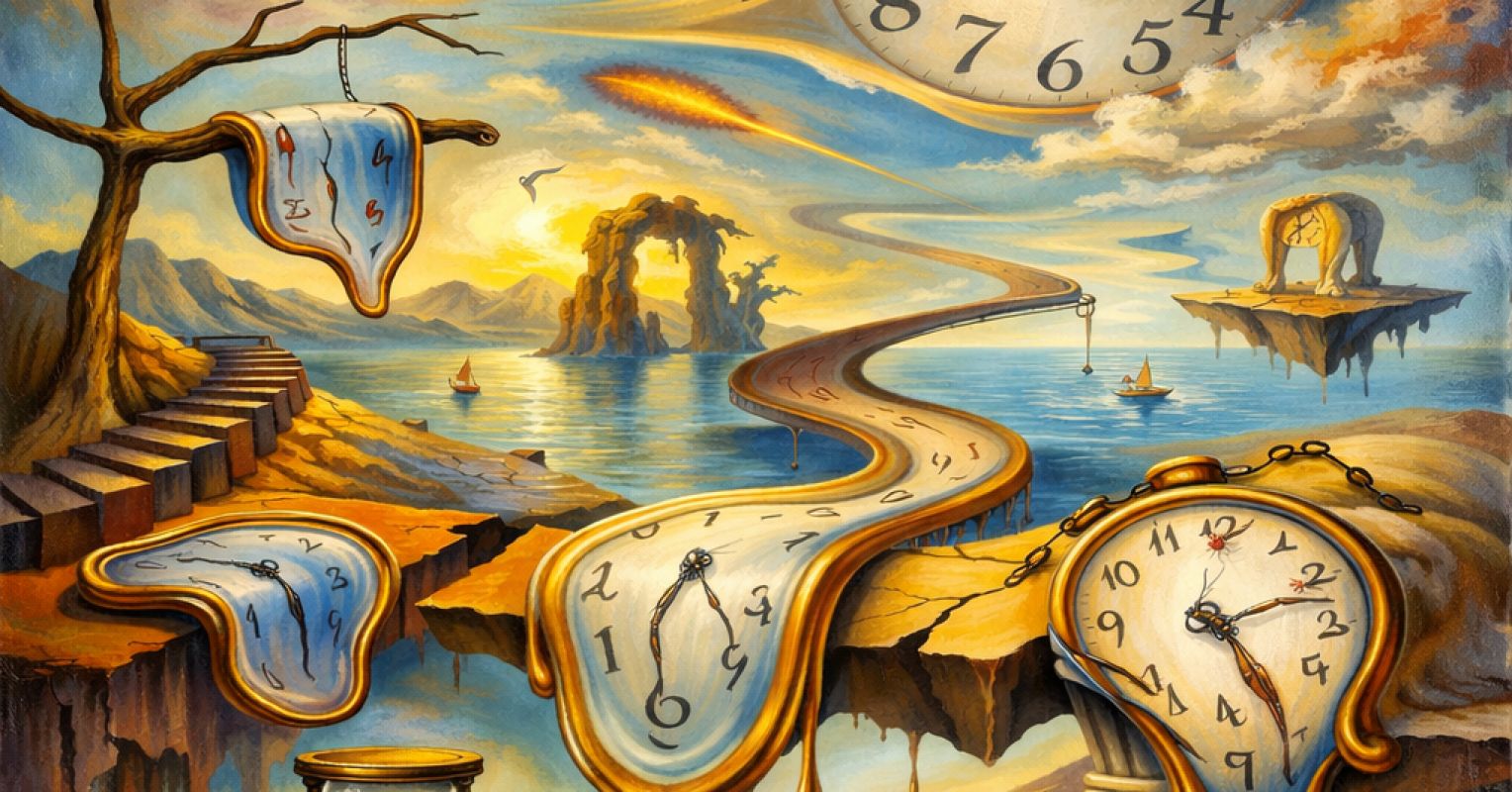
For much of our existence, clocks and calendars did not exist to mark time. Instead, we lived according to the cycle of day and night. Weather, hunger, or seasons dictated when we ate, slept, and moved season to season continuing to survive. As humans, we have always lived spontaneously, in tune with natural rhythms, not according to an artificial, structured format. The idea of time as a scarce resource to be measured, tracked, and optimized is a recent invention. It now places a strain on the human mind. A strain that our biology was never built to handle.
The brain has been constructed to respond to the present moment. The brain does not react to external timelines or anticipated timelines because that’s not how humans evolved. The way in which the brain evolved for memory, attention, and emotion was to promote immediate survival by focusing on environmental factors like danger. Animals exist in the wild by reading their environment and following established patterns. Human beings share the same nature. In addition to being guided by their biological makeup, humans now exist in an environment that compels them to always plan, track, and predict the future. Every minute of the day is accounted for. All tasks conform to the schedule of the day. Over time, this creates an inconsistency between how the brain has evolved versus how it has been conditioned to perform in this new, modern, and rapidly changing society.
The Evolutionary Bias Toward the Present
The physical body is not aware of time deadlines as neutral but rather as a danger. The body perceives these time pressures or deadlines as potentially threatening to the individual’s health and well-being. As an individual experiences repeated instances of time pressure, the physical body does not have the opportunity to recover and fatigues as a result. McEwen (1998) described this process as allostatic load, the cumulative cost of being under constant stress. When people find themselves under constant time pressure, their stress reactions remain active all the time. Chronic stress leads to increased levels of anxiety, sad moods, irritability, and mental fatigue over time.
The actual cause of chronic stress is not the effort or challenge, but rather the continual nature of time pressure on modern routines of everyday life. Time pressure can be beneficial in small doses as it increases focus and motivation. However someone subjected to continual time pressure absent natural breaks doesn’t have a chance to recover. Many people feel guilty for taking a break from hectic schedules, adding even more pressure and stress to their already overworked bodies. Lazarus and Folkman (1978) argued that when an individual perceives an ongoing, excessive workload as uncontrollable, they suffer greater strain from the stresses associated with that constant demand. Without an endpoint for the demands on their systems, it is impossible for the nervous system to rest.
When Clocks Replaced Rhythms
The introduction of mechanical clocks and industrialized working patterns fundamentally altered our relationship with time. The natural rhythms at which work was previously performed were replaced by hourly and minute-based measurements. Work output was associated with increased levels of productivity and speed. Over time, the idea of “being busy” became a symbol of responsibility and value. In many workplaces today, a full calendar is treated as evidence of value, while slowness is viewed with suspicion.
This shift has psychological consequences. Time becomes something to manage and control rather than something to move within. People begin to measure themselves by output and availability. The faster life becomes, the more pressure people feel to keep up. Rosa (2010) described this as social acceleration, a condition in which increasing speed produces not relief, but a growing sense of time scarcity. Even as technology saves time, people feel they have less of it.
Constant time pressure also changes how attention works. Focus shifts toward what comes next instead of what is happening now. Conversations become efficient rather than meaningful. Leisure feels unjustified unless it has been earned. Unstructured time can feel uncomfortable or even anxiety-provoking. Zimbardo and Boyd (1999) found that people who are strongly oriented toward the future, especially when they feel little control, report higher stress and poorer mental well-being.
Time Pressure and Mental health
There has been a marked increase in anxiety and depression over the last several decades for a variety of reasons. An increase in the saturation of time needs or demands is part of that picture. Digital technology also increases pressure. People have calendars, reminders, notifications, etc., with them no matter where they go. There is less separation between working time and resting time. For many people, there is an ongoing feeling of being “behind” on their work and never finishing what they started. Therefore, if the pressure of time is creating distress for many, we cannot expect that good time management alone will allow a person to experience relief from this distress. To find relief, we must reduce the relevance of time as a measurement of worth, being, or safety. This does not mean removing all structure; rather, we must allow for more flexibility within the existing structure. For instance, many people find that engaging in creative activities (such as play or unscripted conversation) is restorative because those activities provide an opportunity to experience a break from the ongoing pressure always to be focused on the next thing; when a person can return their attention to the present, this is where the brain can perform at its highest level.
Although treatment is a vital step toward solving Mental health disorders, many people are not going to heal from their current Mental health problems through treatment alone. Many will need to examine how they view time as it relates to the value and identity a person has, as well as how they view themselves and the way they work. When individuals determine their worth based on productivity and quickness, they are going to feel stressed. The level of stress may be great enough that it will create chaos in their lives. Ultimately, by eliminating time as an absolute standard or expectation, there are opportunities for new perspectives regarding emotional well-being based on presence and rhythm. Being human is not a “finished product” but an ongoing journey.