



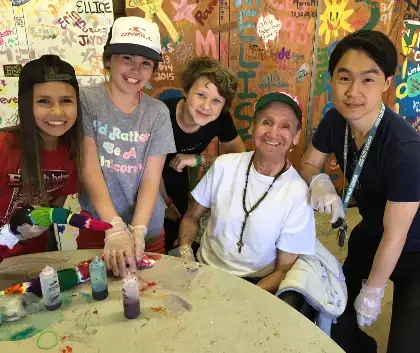
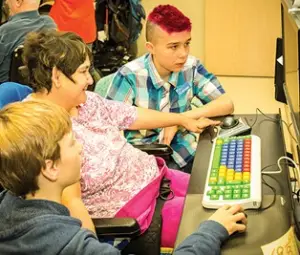
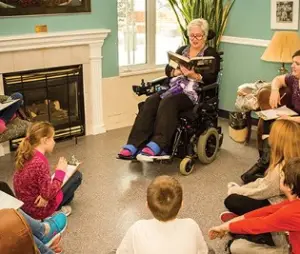
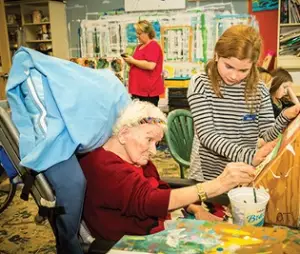
In Saskatoon, Canada, a group of sixth graders spend their school year outside their normal classroom and at the Sherbrooke Community Centre, engaged in conversation and activities with the long-term care residents who live there. One day, they might be found journaling, another learning new technologies, or writing limericks with the “elders,” many of whom have dementia or other conditions. Or they might be gardening, helping out at the center’s gift shop, or working on an art project.
“From my work with elders, I learned stories, games, and how to become a better person,” said a student named Mya. It even relieved despair for one resident, Jodi, who said, “I went from a daily dread that I was still alive and breathing . . . to anticipat[ing] an awesome day that was full of life and joy.”
Many extracurricular activities, sports, meetups, and other community programs bring people of similar ages together: children with children, teens with teens, adults with adults, seniors with seniors. But new research on an intergenerational program known as iGen suggests that these initiatives may be especially beneficial to our health and well-being.
Finding meaning in connection
X
For the study, the 25 participating students—as well as three elders and eight long-term care staff members—completed a variety of surveys. At the end of the day, they rated how meaningful their interactions with different groups of people were, how much fun and positive and negative emotions they had, and the quality of their physical health that day. They also reported how many kind and helpful actions they performed, and how strong their social connections and sense of belonging were.
Everyone completed surveys for 10 straight school days in late September and early October, and then again in June.
The results suggested that people were experiencing meaningful interactions between generations, and highly meaningful interactions with their peers of similar ages. While people didn’t become happier, healthier, or more kind overall over the course of the program, the researchers did observe changes on a daily basis.
On days when people had more meaningful interactions, they tended to feel better, more connected, healthier, and kinder. This was true for both interactions with people the same age (like students with students, or elders with elders) and intergenerational interactions—although the benefits seemed more pronounced between generations than with peers.
This link appeared even stronger toward the end of the program than near the beginning. In June, having meaningful interactions through iGen seemed to have an even bigger impact on people’s well-being than it did in the fall. The researchers, led by Jason D. E. Proulx, now a postdoctoral research fellow at the Australian National University, suggest this might be because students had deepened their relationships with elders by that point, or they were savoring their last few weeks together.
The length and depth of this program—spending whole days together over 10 months—may have contributed to how powerful it was, the researchers suggest.
Although this research only reflects one program, with a majority of white participants, it offers promising evidence that programs like this can help young and old alike, and comprise a valuable part of students’ education. Other research finds that interacting across generations can improve Mental health and cognitive function in older people, and a sense of purpose for all of us.
“Programs like iGen may be one effective and scalable intervention to foster more inclusive, meaningfully connected, and happier communities,” write Proulx and his colleagues.
Mya’s mother Tanya said that she “built long-lasting friendships with the residents . . . but also learned the value and appreciation of life.”
“It took those sixth-grade kids to bring life back into focus for me,” said Jodi, who had thought her life was over and sometimes wanted it to be. “iGen saved me.”