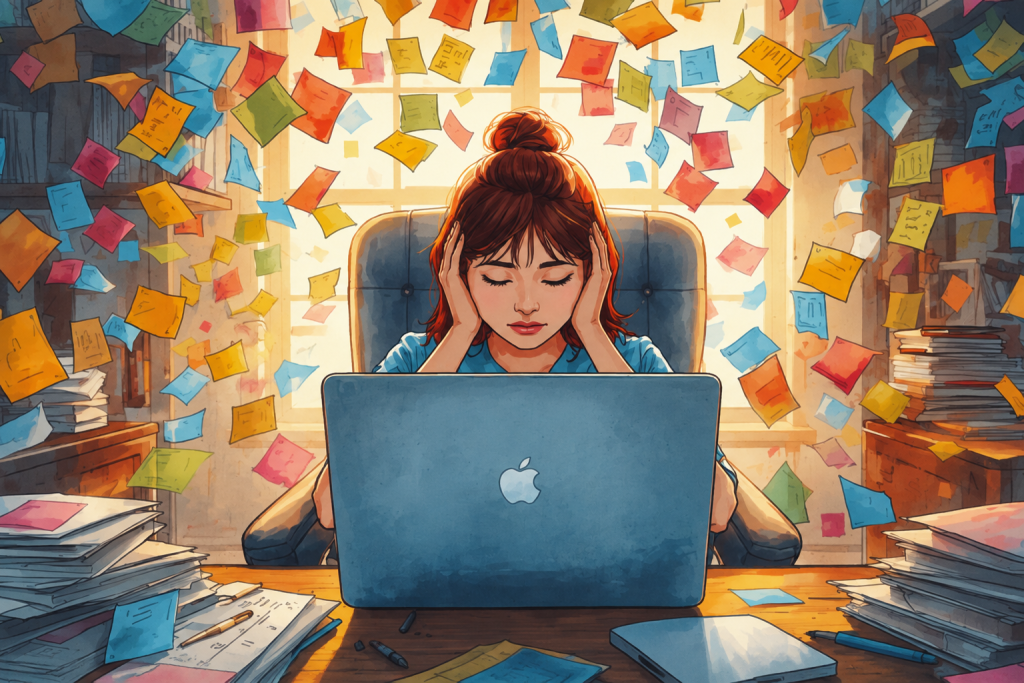




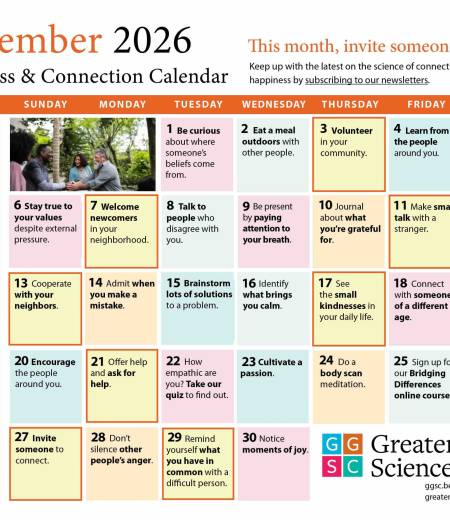
As numerous surveys suggest, people today often feel overwhelmed by new technology, global crises, and loneliness. What do the nation’s psychologists recommend? At the annual convention of the American Psychological Association last month in Washington D.C., that turned out to be a return to the basics: tending to our bodies, connecting in-person, and caring for each other and the most marginalized among us.
Joy D. Calloway, president of the Black Women’s Health Imperative, urged attendees to recognize that just because people are functioning at work and home doesn’t mean they’re flourishing. The chronic stress builds up over time and becomes biological harm, Calloway said, citing the weathering theory described by Arline Geronimus, a public health researcher at the University of Michigan. Calloway continued:
The field of psychology has an extraordinary opportunity in this moment, not only to measure how people adapt to adversity, but to understand and influence the conditions that create and sustain wellness. . . . Perhaps our greatest blind spot is that we’ve confused resilience with wellness. . . .
Advertisement
X
While wellness begins with individuals, it is nurtured by families, strengthened by communities, and made possible by the systems, institutions, and policies that create the conditions for people to thrive. We don’t simply practice wellness; we build it collectively.
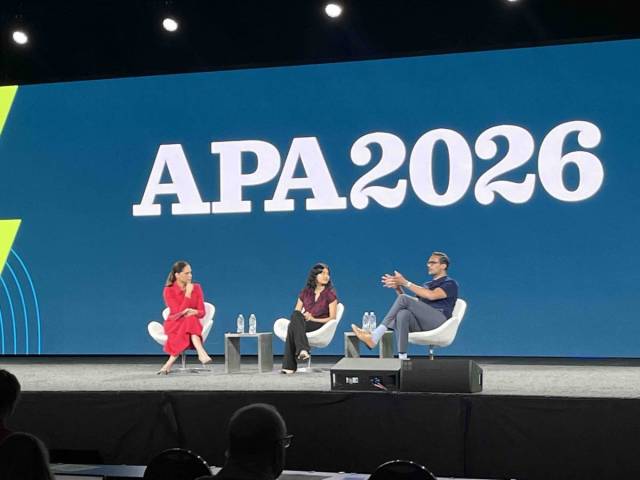
Over three days, nearly 8,000 people from 60 different countries attended the conference in person, participating in a program that included 523 different sessions and 1,180 presenters. The scientific poster program included 91 poster sessions, 2,115 posters, and 1,921 presenters.
Grappling with overwhelm
In sessions on supporting youth Mental health, the impact of technology, and “adulthood unmoored,” APA speakers agreed that many of us are struggling to find purpose and optimism amid technological, climate, and global disruption.
Psychologist Ali Mattu noted that over a decade ago, clients sought relief from stress and anxiety, which evolved to seeking relationship and connection support. “Now it’s despair, overwhelm, and meaning,” Mattu told the mainstage audience. “Anyone below the age of 50 here is really searching for meaning, connection, hope, and what do I do with all this overwhelm? What do I do with all of these systems that seem to be collapsing?”
Perfectionism and the paradox of choice often lie at the root of the overwhelm, said Thomas Curran, associate professor of social psychology at the London School of Economics. “We don’t worry about what we are doing; we worry about what we could be doing,” Curran said. “It’s like swimming in a vast expanse of ocean with nowhere to dock. It’s frightening, and it feels like no matter what we do, it’s never enough.”
The answer, Curran said: “Microdose bits of discomfort into daily life.”
For young people, positive change means pushing back against the ubiquity of technology that purports to connect us but actually keeps us in separate bubbles, staring at our individual feeds. As Nikki Iyer, an undergraduate at the University of California, Berkeley, framed the problem:
Our generation might be the most connected generation, but we’re also the loneliest generation. We’re the most alienated generation, and we are desperately craving social connection that we don’t know how to tap. . . . There’s so many people around you all the time. You’re on the train together; you’re in parks; you’re in cafes, but everyone is looking down, and that is a horrific way to grow up as social creatures.
Iyer noted that tech firms wouldn’t be spending such unprecedented amounts of money on lobbying and marketing if they didn’t realize there’s a surge of resistance to artificial intelligence and social media dominating our lives. “The world is in our hands if we are willing to make the leap,” she said, noting a return to “weird” hobbies and in-person activity that replace digital time. “I see a lot of young people pushing back against that.”
AI models were trained on disproportionately white male–oriented data sets, noted Brendesha Tynes, professor of education and psychology at the University of Southern California’s Rossier School of Education, in urging a slowdown in the adoption of AI.
“Anti-Blackness is the default setting in AI,” Tynes said. Young people need skills “to identify, critique, and cope with the algorithmic bias in technologies that they might witness, and then also to eventually create better AI technologies that don’t have anti-Blackness bias.”
Intentional connection and advocacy
In sessions across the three days of the conference, researchers presented papers and models for identifying and building on resilience in marginalized communities, from LGBTQ+ youth and adults to disabled and racially marginalized people of all ages.
Joshua Parmenter, an assistant professor at Arizona State University, presented a resistance-resilience model with sexual- and gender-diverse people of color, which involves both individually untangling messages that undermine your well-being and finding collective ways to reclaim power. Jules Soper, a researcher at the Oklahoma State University, offered an investigation of resistance strategies that trans and gender-diverse people use in states that are passing anti-trans legislation.
Alvin Thomas, an associate professor at the University of Wisconsin, Madison, noted that anyone can play a positive role in supporting another member of the community. “I have zero kids, and yet I will still call myself a father. I have nephews; I have nieces; I have kids that I mentor from across the Caribbean and across the U.S.,” Thomas said.
Clare M. Mehta, professor of psychology at Emmanuel College and visiting researcher at Royal Holloway, University of London, encouraged everyone to look for ways to be a “villager” who reaches out to another person, and seeks out connection in third spaces. She continued:
We have to start going back to the pub again. People have been concerned for years and years that drinking alcohol is bad for your health, but not connecting with people socially is even worse for your health. . . . You don’t have to drink alcohol at the pub. They serve other drinks, right? Go and have a glass of orange juice or like a fizzy water. Not connecting with people socially is even worse for your health.
Young people actually are wired to be a positive force for change, said Eva Telzer, professor of psychology and neuroscience at the University of North Carolina at Chapel Hill.
“Young people are superhuman in the way their brains are set up to be risk takers but also to care about others, for peers, and for social interactions to be so important,” Telzer said in a question-and-answer period after her mainstage remarks. “That puts them in this perfect place to make change and do good in the world.”
Even technology has a role to play, Mattu said. “AI should be a co-intelligence that enhances the things we are very bad at,” he said, urging people to take the opportunity to define clearly the uniquely human pursuits we should claim, and in which domains technology is appropriate to be a useful aid.
He suggested three criteria for the activities to avoid replacing with AI: what you love, what you have expertise in, and what you hold high standards for. As Jacqueline S. Mattis, a psychologist and dean at Rutgers University, Newark, told her audience:
We start as this passel of cells, and then we end up laughing, and that’s amazing. You get to experience the magnificence of being able to feel affection for another human being, so much so that you will sacrifice everything for them. That’s amazing. . . . All of that is what defines us as truly human and defines this thing called life as worth living.