





Each morning after meditation and prayer, I envision the encounters that I anticipate at home or at work, and I ask myself: “How do I need to manifest love for this particular person today?”
As a medical school leader, I rarely hear the people around me talking about “love,” per se, but they often have conversations about the 10 common forms it takes: celebrating meaningful accomplishments, providing compassionate care, forgiveness for those burdened by their inevitable mistakes, attentive listening, “carefrontation,” helpfulness, loyalty especially for people who struggle to keep friends, respect, uplifting mirthfulness that can help reframe perspectives, and creativity, especially for those whose projects get stuck. To practice “love leadership,” we all need to ask how love manifests in everyday living according to people’s unique needs.
We can resuscitate love in the home, the workplace, the community, schools, the environment, the government, and within our own hearts, where it really must begin. How can we find and maintain an inner peace, even in times of overwhelming anxiety? The answer begins with love—and not just any love, mind you, but with Pure Unlimited Love. This is the time for love to rise more beautifully than ever before.
X
When the security and well-being of another is as real or meaningful to us as our own, and sometimes even more so, we are within the field of love. Human love tends to be myopic, unenduring, and sometimes unwise. This is where spirituality comes in. Pure Unlimited Love is mystical and metaphysical. It is the first thing you see and feel when you close your eyes for the last time, hopefully. Here are seven pathways toward greater love in the world, submitted for your consideration.
1. May you give and glow
Both research and our personal experience show that givers are better off emotionally and physically, whether people return the kindness or not. Although you can never count on reciprocation, you can always count on the meaning and the inner glow of giving. “Glowing” is my synonym for well-being and inner peace.
This is the one source of resilience in our lives that we can most depend on and that is always available for the choosing. Giving and glowing is the general subject of more than 50 papers I’ve published in medical and psychology journals over the past four decades, and connected to the “flow” described by scholar Mihaly Csikszentmihalyi.
Our research has given us a general dosage for volunteering: 100 hours per year, or a couple of hours per week. This is enough time to get fully immersed in an activity and even to lose sense of time and place. It is not the case that the more one gives, the better one feels.
Simple acts of loving-kindness can transform us emotionally when we might otherwise get sucked down into despair and resentment. Emotions often follow actions, just as actions follow emotions. Kind giving creates dignity and worth. Studies of the brain indicate that when the circuits for kindness are turned on, the circuits for bitterness and hostility turn off.
Kind giving provides benefits in a variety of communities and across the lifespan, research finds. We can celebrate our kind giving in everyday life between the spheres of love: the mix of the nearest and dearest (like family and friends), and the neediest and all living beings (including nonhuman species).
2. May you heal with kindness
Most people are hurting and suffering to some extent for some deep reason that we know nothing about, so we must always be kind. Anything less does a lot of hidden damage. Kindness is the minimal expression of love, requires no great training, and is appreciated by everyone, especially those feeling a bit empty inside or maybe burned out from a long day. This is when a simple smile or thoughtful action can lift the soul. Yes, we are all healers when we are kind.
Simple kindness calms the destructive emotions and anxiety that beset almost everyone, especially in times of deep social and cultural polarization. Young adults who report having experienced parental kindness rather than emotional or physical violence experience half the rates of mental and physical illness in midlife and tend to avoid alcohol or drug abuse as teens. Patients who receive empathy from their physicians and nurses are more likely to continue with challenging medical treatments, share important information about their illness, and live healthy lives. This is what we research here at Stony Brook in the Renaissance School of Medicine.
Destructive emotions have been associated with Alzheimer’s disease. When angry or anxious, our elevated stress hormones shrink the hippocampus—the part of the brain needed to lay down short-term memories. A well-known prevention study found that private spiritual activity reduced stress, enhanced kindness, and in turn reduced susceptibility to Alzheimer’s. People also heal faster because kindness reduces stress, strengthens the immune response, and fosters resilience.
Empathic care benefits medical students, clinicians, nurses, residents, and other staff members, as well. Studies find that when clinicians can maintain kind care, they find practice meaningful and are more resilient. Importantly for anyone in medical education, the Journal of the American Medical Association reported in 2018 that medical students who are more empathic in medical school have lower burnout rates in residency. When clinicians are satisfied with their relationships with patients, we see reductions in professional stress, burnout, substance abuse, and suicide attempts.
Several of my physician colleagues here at Stony Brook developed an approach to increase empathy and compassion on the clinical floor. We came up with “Stop, Look & Listen” as the key to kindness. Generating a kind and gentle curiosity about patients makes them feel at ease, leading to more productive and better communication throughout the day. It speeds wound healing and adherence to burdensome treatments, especially in chronic illness.
3. May you follow your callings
More than just a job or occupation, a calling is being beckoned to draw on your abilities. Just as we each have a unique biological fingerprint, we each have a distinctive combination of talents and gifts. In our individual uniqueness, we contribute meaningfully to the lives of others.
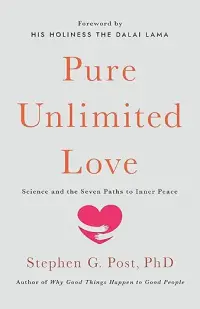
This essay is adapted from Pure Unlimited Love: Science and the Seven Paths to Inner Peace (Morehouse Publishing, 2025, 256 pages).
Callings can be simple or complex, but they are all worthy of equal regard and respect. Following callings, whether a gradual well-mentored development, a singularly unexpected experience, or a combination of these, is not always easy. A calling can feel invasive, breaking into our otherwise “good enough” lives and disrupting us to a higher consciousness of who we are meant to be. It often means taking the road less traveled, a road often filled with adversity and challenges. But if you love what you are doing and feel called to it for the sake of love, then you will find inner peace. You will never consider straying.
An estimated half of working Americans have a sense of meaning and calling in their jobs. But only about half of those with a sense of calling are able to live this out due to circumstances and lack of opportunity. Those who live out a calling are the happiest workers, the most committed, the least mentally ill, the most engaged, and the most productive. They are also the healthiest. One of my favorite studies finds that older adults who rated in the highest quartile on a purpose of life scale had a 30% lower rate of cognitive decline than those who rated in the lowest quartile.
During my two decades as a professor at Case Western School of Medicine, I would sometimes drive an hour west of Cleveland to visit Edison’s birthplace farm in Milan, Ohio, not far from Oberlin. One of the most prolific inventors of the Industrial Age, Edison was expelled from school at age 12 because his teachers had given up on him. They thought he had no focus, no potential, and no hope, and bluntly conveyed this judgment to his mother.
Edison’s loving mother encouraged young Thomas to invent things from “junk” items in their big red barn. She told him that someday he might even become “a light to the world,” as he did. His mother’s love and vision redeemed him from the humiliation he suffered in school. Thomas would spend whole days in their old barn. Edison’s mom loved him so much that she helped him dream. He was not brilliant in the ways that allowed him to “fit in” at school. He had a different kind of brilliance, an inventiveness that enabled him to see how objects might fit together.
If you are struggling to find a calling, ask yourself not what you want to be but what problems you want to solve and who you feel called to serve. Your calling does not have to be grand or spectacular externally. But you do want to be what I call a “passionary.”
4. May you raise kind children
Children are born to be kind, science says. But kindness depends on the quality of a child’s exchange with their surrounding world, and that exchange begins in their families long before a child speaks any words. Kindness in the child can only be awakened by kindness, and so it’s become more and more evident that we must raise kind children—or leave them without hope in a world that’s more and more difficult to navigate.
Various experiments show how easy it is to fan children into aggression. A Secret Service study found that 71% of school shooters have been bullied. By age three or four, Protestant children in Belfast hate Catholics, and vice versa; the same can be said for children in many other places.
A landmark 1998 study of more than 13,000 adults found that a larger number of adverse childhood experiences (ACEs) corresponded with greater risks of destructive behavior and illicit substance use, psychological issues, and reduced life expectancy. The same relationship was found between the number of ACEs reported on the survey and the number of negative health outcomes experienced in later life, including heart disease, cancer, and skeletal fractures. Some of the more salient outcomes and risk behaviors included depression, suicide attempts, alcoholism, and drug use. These early life detriments can be overcome in adolescence and adulthood with good communities and relationships, such as the right spiritual community, the right mentors, warm friendships, a compassionate and understanding spouse, and counseling.
Kindness between spouses is passed down like a sacred torch to children. Children notice all the details of parental interactions, and if they see and hear mostly simmering hostility and harsh arguments, they are left feeling sad and unloved. If this is protracted, the results can be damaging in the long term. We as couples need to care for one another, and even in the context of divorce, never “weaponize” our children. Strategies like a family mission statement, a weekly meeting, and volunteering together can build these bonds.
Pitirim Sorokin, Harvard’s first professor of sociology, studied “good neighbors” in the United States dating back to the 1950s. Sorokin’s research found that families characterized by high values, harmonious relationships, and wise love raise children who are more likely to be caring, compassionate, and giving. After studying the lives of people widely recognized in their cultures for generous and compassionate behaviors, Sorokin concluded that we can expect with high probability “a remarkable vitality, a long duration of life, an unperturbable peace of mind, and an ineffably rich happiness.”
My Institute for Research on Unlimited Love has supported programs as early as 2005 on small group circles of trust, even in first and second grade, focused on virtues such as kindness, forgiveness, and generosity, as well as meditation. It turns out that these dynamics in early grade school tend to reduce aggressive behaviors and encourage better school performance.
You don’t need to be a parent to guide children on the path of kindness. Every teacher, babysitter, neighbor, relative, coach, minister, or literally any adult who spends any time around children, including the school bus driver, is absolutely able to contribute to the common goal of raising kind children. This is a job for everyone, without exception.
5. May you know the One Mind
What has been most important in my own quest for inner peace is being aware of and connecting with the One Mind. Knowing the One Mind or, as it is often called, the “Universal Mind,” is a valuable treasure that, when at full strength, is undisturbed by the turbulent outside world. Although the brain is the platform for mind, mind is so very different from tissue. Mind is pure consciousness, or that which precedes matter. Those acculturated to Hindu and Buddhist cultures think that consciousness can only be understood as pure mind, underivable from matter.
Carl Jung had the universal mind in view when he wrote about a collective unconscious and the “uncaused causality” of synchronicity. When we experience this oneness, we sense that we are more cherished by the universe than we know. Perfectly timed events and interactions take place so improbably that they seem not random. Jung called this “synchronicity.”
Many people in the United States are aware of the One Mind, otherwise known as “Universal Mind” or “God.” In our widely reviewed Heart of Religion Survey (2013)—a scientific survey of randomly selected U.S. adults—Harvard University’s Matthew T. Lee, the now deceased Margaret Poloma, and I learned that about 81% of American adults feel God’s love directly, at least once in a while. Almost half (45%) of all Americans feel this higher love at least once a day and almost half (48%) of the respondents who had a strong sense of purpose directly experienced God’s love daily or more, as compared with the 14% who had a strong sense of purpose but never experienced divine love.
Meditating is listening to the One Mind; praying is speaking to it. Feeling the presence of this source is necessary if we are to be consistent instruments of peace, fully sow love over hatred, reliably sustain realistic hope over despair or mere dispositional optimism, focus healing light energies in times of darkness, or find deep joy despite sadness.
6. May you cherish the gift of nature
The beauty and mystery of nature—even when indoors—has the power to fill us with awe and bring heart and mind to a peaceful space. Awe is an emotion that flows from the experience of wonder before a fabulous mountain view, when gazing about a vast and ornate cathedral, or when sensing the beauty of another human being through their actions of kindness. It is triggered by an awareness of something vast and beautiful, like when walking into a deep forest and being quietly overwhelmed by its majesty. Awe is a sublime emotion, a feeling of wonder, astonishment, and reverence. It is associated with attitudes of respect, admiration, fascination, exultation, calmness, and even a touch of fear.
According to psychologist Dacher Keltner, awe is one of the most important positive emotions, and it benefits us in numerous ways, including enhanced feelings of well-being, generosity, and humility. In 2022, Keltner’s group published one of their many studies on how older adults can experience social disconnection, anxiety, and sadness, all of which adversely affect aging and health. Those who took 15-minute “awe walks”—strolls during which participants gave mindful attention to nature—did better on psychological surveys for Mental health and positive emotions such as compassion and gratitude.
Nature is a door to the spirit behind and within the universe, and awe takes us through the door. These perennial truths have been made current by science.
7. May you honor the spirit of freedom
Internal freedom is a gift of the spirit. It is an aspect of the original One Mind that lies within each of us. When we yearn to follow a calling, create a piece of art, or change the course we’ve taken in life, we are feeling internal freedom—the freedom to cocreate with Pure Unlimited Love, even if we are not using this language. Internal freedom requires inner practice of mindfulness, meditation, prayer, and spiritual beauty, like the lotus—the universal and especially Eastern symbol of spirituality (purity, freedom, love, rebirth, resilience, healing, enlightenment) because it emerges beautiful from the muddy water in the morning and is radiant, opening as the sun also rises. We can remain pure in mind and heart regardless of murky context, rising and blooming above all adversity and darkness.
How do we exercise external freedom? By defying those who would steal our freedom and by setting up social and political structures that allow us to resist those who would abuse power. The power of love has always resisted the love of power, and both aspects are real in the world.
Freedom is essential to all the ways of love, both as a starting assumption and as a product. Simply stated, there can be no love without freedom, and no manifestation of love without freedom.