


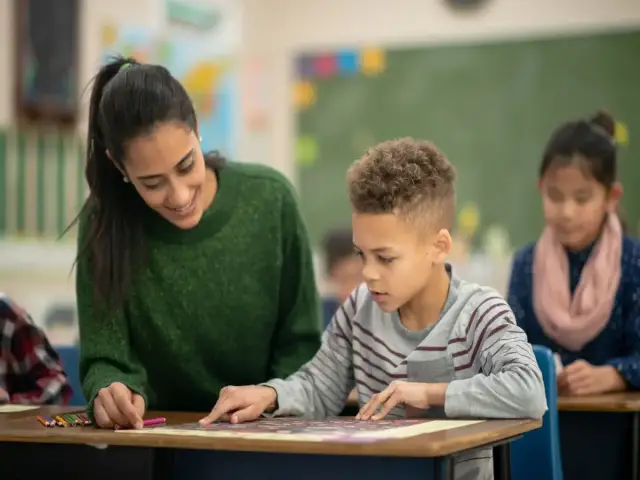
Teachers, think back to when you were your students’ age. Picture yourself: who you were, how you spent your time, what mattered to you.
Now, bring to mind an educator you felt close to. Someone who saw you for who you were and even who you could be. What did it feel like to be around them?
Next, shift your attention to an educator you were not close to. Someone who couldn’t or wouldn’t see you. How did it feel to be near them?
X
Most of us still carry these experiences with us, decades later. We know firsthand that these relationships shape us long after we leave the school building. The good news is that we know a lot about what makes the positive ones so powerful and how to build them.
Research consistently finds that positive student-teacher relationships have a significant impact on students’ engagement, social-emotional development, and academic success—as well as physical and Mental health in adulthood. And the benefits go both ways: For educators, positive student-teacher relationships predict greater teaching efficacy and higher levels of well-being.
Of course, building these relationships isn’t always easy or straightforward. One of the biggest barriers is implicit bias, which refers to the attitudes or stereotypes that unconsciously affect a person’s perceptions, actions, and decisions. For example, educators might consciously hold egalitarian personal beliefs while unconsciously associating Asian students with being quiet, compliant, and self-sufficient or Black and Brown students with being loud, disruptive, and aggressive.
Implicit bias can make it harder for us to see our students for who they truly are and could be. But the more we understand about how these biases work, the better equipped we are to move past them and toward the kinds of relationships that change lives.
Implicit bias in education
So, where does implicit bias come from—and how does it show up in schools?
Implicit bias is the result of our brain’s natural wiring for quick, automatic processing and living in a society permeated by the smog of racism, sexism, homophobia, transphobia, and other forms of prejudice.
Due to our frequent exposure to bias, our brains encode these prejudiced ideas for when we need to make split-second decisions. Because none of us are immune from breathing in the smog, no one is immune from implicit bias—not even well-intentioned, caring educators.
There are certain conditions called “vulnerable decision points” in which people rely more heavily on quick, unconscious processing. These conditions include time constraints, exhaustion, frustration, stress, and even hunger. In her article “Understanding Implicit Bias: What Educators Should Know,” Staats writes: “Given that teachers encounter many, if not all, of these conditions through the course of a school day, it is unsurprising that implicit biases may be contributing to teachers’ actions and decisions.”
In K–12 education, implicit bias contributes to disparities in academic achievement as well as discipline. When looking at relationships, students of color are less likely to have close connections with their teachers, and implicit bias is suspected to be a major contributing factor. In other words, implicit bias can determine whether a student experiences us as the adult who saw them or the one who didn’t.
A plethora of trainings and interventions focus on identifying, reflecting on, and excising implicit bias. Unfortunately, implicit bias is resistant to removal.
Luckily, researchers have found a more effective intervention that focuses on disrupting the implicit bias before it becomes behavior. Even better news? Focusing on changing behavior can weaken implicit bias over time, making it possible to build the positive relationships we hope for with all of our students.
How educators can counter implicit bias
According to neuroscience, there are three ways to disrupt implicit bias before it becomes behavior:
- Identify the disconnect between implicit bias and your values. Implicit bias often operates in direct conflict with what we consciously believe. The first step in disrupting it is recognizing when our automatic reactions don’t match the values we hold.
- Prevent reactive behavior stemming from implicit bias. Once we notice the disconnect, we need the ability to pause before acting on it. Regulation strategies like pausing and breathing give us the chance to stop our automatic reaction.
- Choose a values-aligned response. With that pause, we can deliberately choose a response that reflects how we actually want to show up for our students: one rooted in the beliefs and commitments that brought us to this work in the first place.
Just as we plan for our students’ needs, we as educators can plan for our own needs, too. We’re going to suggest a three-step reflective process for educators that turns these neuroscience insights into a Self-awareness that can help replace behavior influenced by implicit bias.
This process can be used at any time during the school year and with any student. To get started, consider a student who is on your mind right now. Maybe it’s someone you’re struggling to connect with at the start of the year, one whose behaviors you find challenging midway through, or one who continues to mystify you as the year winds down. The best time to get started? Right now.
Step 1: Get curious and name what you want to change. The first step is to get curious. There are a series of activities and reflection prompts below that will guide you through looking closely at yourself, your student, and your relationship.
Ground yourself in your values. Before looking outward, look inward and start with what matters most to you. Your values are the foundation for the kind of educator you want to be and the relationships you want to build.
- Identify your top three to five values as an educator by completing this values-based exercise.
- Take a minute to visualize the settings in which you work with students (e.g., class, hallways, after-school club, etc.). What do these values look like in practice? What do you want your relationships with students to look like? How do you want your students to feel?
Choose a student and reflect on your relationship. Now that you have a clearer picture of your values and your vision, it’s time to identify a student you’d like to build a stronger connection with.
Select a student. How would you describe your relationship with them right now? How do you feel about them?
Look at your patterns. When things get difficult with this student, how do you tend to respond? What do you do or say? To what extent are you practicing your values in these moments?
Consider the role of implicit bias. Next, look beneath the patterns you’ve identified. Implicit bias often operates outside of our awareness, so this step asks you to consider what might be fueling those behaviors.
- Think about your and your student’s social identity markers. Which ones feel salient to this situation? What unconscious beliefs might you have absorbed about these identities?
- Reflect on when you’re most vulnerable to snap judgments. Consider the time of day, location, and your state of mind. When are you most tired? Hungry? Stressed? These are your vulnerable decision points.
Name what you want to change. At this point, you’ve grounded yourself in your values, looked honestly at a relationship, and considered how implicit bias might be showing up. Now get specific: What is one behavior you want to stop, and what values-aligned behavior do you want to replace it with?
When I reflect on my values, connection and inclusion rise to the top, and yet (for example) when I think about my student Justin, I can see I’m not living those values. We’ve butted heads since his first week in my class, and somewhere along the way, I stopped asking about him or his interests and shifted into conflict-avoidance mode instead. Thinking about the role implicit bias might be playing, I notice that Justin is a tall Latino male who looks older than his 15 years, and I wonder if I’ve unconsciously held him to a standard of maturity he doesn’t have yet.
As a first step, I want to focus on transitions, which have been the source of most of our tension lately. When I ask the class to shift tasks, Justin resists, and I get frustrated. My new approach is to give him a quiet heads-up before any transition so he has time to prepare, and if he still needs a moment, I’ll check in with him one-on-one rather than calling him out in front of everyone. The goal is to replace my reactive pattern (frustration, public correction) with something values-driven: a genuine invitation to join the class in what comes next.
Step 2: Tune in and try out the response you want. The first step happened in a reflective space. This step happens in real time, in the moments that matter most. When you notice that reactive behavior coming up with your student, that’s your cue to pause and practice. The following process is adapted from Zarretta Hammond’s SODA Strategy, which is described in her 2015 book, Culturally Responsive Teaching and the Brain.
Tune in. Your body often registers implicit bias before your conscious mind does. Learning to notice those signals gives you the chance to choose your response rather than react on autopilot.
- Tune in to your internal landscape. What thoughts are you having? What emotions are you feeling? What is your body telling you? A flash of heat, a rolling stomach, a clenched jaw? These are all data.
- Take a moment to ground and care for yourself. Grounding practices could include taking a few deep breaths, thinking about a soothing place, washing your hands, or stepping outside. Even a small pause can help you shift from reactive to intentional.
Try it out. Once you feel a little more grounded, try the replacement behavior you identified in step 1. It doesn’t have to be perfect. The goal isn’t to get it exactly right the first time; the goal is to practice responding with your values instead of bias. Pay attention to what happens; these observations will be important for step 3.
Here’s how this might look in practice with Justin: I give him a heads-up that we’ll be transitioning in a few minutes. He nods, but when the time comes, he still isn’t ready. I feel that familiar frustration tightening my jaw, but instead of calling him out, I walk over and quietly check in. He grumbles a little, but starts packing up.
No matter the outcome, you’ve gathered valuable information about yourself, your student, and the relationship. Move to step 3 to continue the learning.
Step 3: Reflect in community. This step invites you to bring all the work you’ve done so far to people you trust. Other perspectives can help us see what we can’t see on our own, especially when it comes to implicit bias. Find a trusted colleague or group to process with. This could look like a regular check-in with a teaching partner, a group chat with colleagues you trust, or dedicated time in your professional learning community meetings. Whatever it looks like, these are your thought partners.
The process below—adapted from Barbara Dray and Debora Basler Wisneski’s mindful reflection protocol—uses description, interpretation, and evaluation to help you and your thought partners separate what actually happened from the stories you might be telling yourself about it.
Describe your experience. Walk your thought partners through the interaction you had with your student, focusing only on the objective facts of what happened. For example: “I gave Justin a heads-up about the transition, and when he did not transition with his peers, I gave him a private, follow-up reminder, and he then transitioned.” Your thought partners’ job is to listen, ask clarifying questions, and gently flag if you’ve slipped out of description into interpretation or evaluation.
Surface your interpretations. Next, name the meaning you’ve assigned to your student’s behavior. For example, I might say: “Justin didn’t transition with his peers even with the extra reminders. It feels like he doesn’t respect my time or his classmates’ time.” This is where thought partners can be especially useful. By listening and offering alternative interpretations, they can surface possibilities you might not have considered on your own. A thought partner might share, for instance, that they themselves struggle with quick transitions, finding it jarring when lessons shift repeatedly over the course of an hour. Another might wonder whether students sometimes struggle with transitions because they are still deep in learning and not ready to switch gears yet. Could either of those be part of what’s happening with Justin?
Examine your evaluations. Finally, look at the judgments you attached to the interaction. Did you attach positive or negative significance to what happened? My evaluation of Justin’s behavior as disrespectful is a negative one. Your thought partners can help you examine whether your evaluation is grounded in what actually happened, or built on interpretations that may be shaped by bias. Is there a more generous way to read the last interaction with Justin?
Plan your next move together. Come back to the values you identified in step 1. With those values and your thought partners’ fresh perspectives in mind, work together to consider what comes next.
- How do you want to respond the next time you’re in a similar moment with this student? Do you want to try the same thing again? Is there another approach to take?
- What support do you need to make that possible? Can your thought partners offer advice, tools, or positive encouragement?
- Commit to trying again and bringing what you learn back to your thought partners.
After processing my interaction with Justin, my thought partners could help me see that his willingness to transition, even with some grumbling, was actually progress, and that quick transitions may genuinely be hard for him. Next time, I want to try acknowledging his effort in the moment, something as simple as a quiet thank-you. I also might think about how I can design my lessons with fewer transitions to support learners who need more processing time. It might not seem like much, but every time I choose to respond in a values-aligned way, I am getting closer to being an educator who sees Justin.
Author and activist adrienne maree brown reminds us that “how we are at the small scale is how we are at the large scale.” Every time we choose our values over our bias, we’re not just changing one relationship—we’re shaping the kind of classroom, school, and community our students carry with them. We won’t always get it right, but this work helps us see our students for who they are and who they could be. And in the process, it helps us become the educators we want to be.