




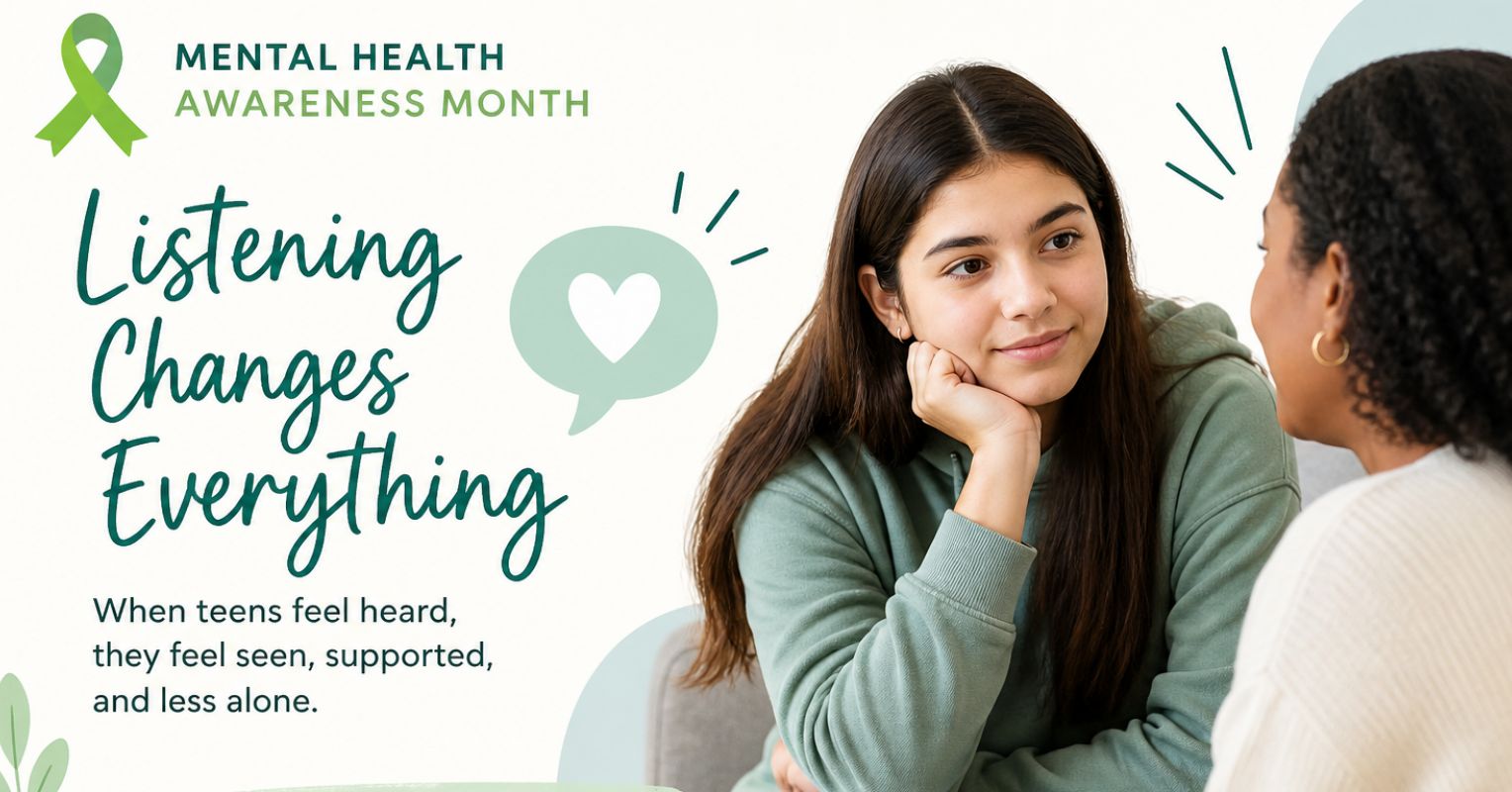
May is Mental health Awareness Month. Sponsored by Mental health America, the 2026 theme is “More Good Days, Together.” National Children’s Mental health Awareness Day is recognized on May 7.
Many factors that influence Mental health are outside of our control. This month (and all year), consider focusing on what is within your control: small, intentional actions that can improve someone’s day. The MHA Action Guide offers many helpful ideas, but one stands out for its impact and accessibility: listening.
A research letter published in JAMA on April 22, 2026, titled “Suicide Mortality Among Adolescents and Young Adults After Launch of a Suicide Crisis Line,” found that the $1.5 billion federal investment in transitioning the 10-digit lifeline to the simpler 988 number, along with expanded services, was associated with significant reductions in suicide mortality among adolescents and young adults. Increased access to supportive listeners is saving lives.
This underscores not only the importance of continued funding for resources like 988 but also the power of listening in our everyday interactions.
As caregivers of young people, listening is one of the most impactful and often most challenging ways we can offer support. It can be especially difficult to listen, rather than jumping to fix, when we are focused on potential risks, from academic concerns to safety and Mental health.
And yet, both research and experience consistently show that listening with genuine interest and without judgment can be a powerful protective factor for youth. While our teens and young adults have access to caring adults every day, meaningful listening does not always come easily. Here are some strategies to help.
Start by observing and showing interest
Validation is the expression of acceptance, and it begins with presence. The first level of validation is simply tuning in. Teens are unlikely to open up if they do not have our full attention. This may or may not involve eye contact. Sometimes the best conversations happen side-by-side, like during a car ride.
Begin by showing interest in daily experiences. Broad questions like “How was your day?” often lead to brief responses (“fine.”) Instead, try more specific prompts: “How did your conversation with the coach go?” or “What are you in the mood for dinner tonight?” These small moments of connection lay the groundwork for deeper conversations later.
If you notice something concerning, start with an observation: “I’ve noticed you seem less talkative lately. Is anything going on?” Whether or not they are ready to talk, your willingness to listen matters. If they aren’t ready, remind them you are available whenever they are.
Listening is an active process
Listening may appear passive, but it requires focus and restraint. When a teen opens up, resist the urge to interrupt or problem-solve. Put away distractions, stay present, and allow them to finish their thoughts.
Be mindful of internal judgments—we all have them. Thoughts like “They’ll never get into college if they keep this up” or “Why would they do that?” are natural, but when expressed, they can shut down communication. Our goal is to keep the door open so we can understand their perspective and offer support when it is most effective.
Instead of judgment, try these alternatives:
- Statements of fact: What have you observed through your senses?
- Statements of impact or consequence: How does the situation affect a goal or outcome? “I want to understand, but when voices get loud, it’s hard for me to focus on what you’re saying.”
- Preferences: Acknowledge differences without criticism (e.g., tastes, interests, or styles).
Resist the urge to fix
With adult experience comes a wise perspective and a strong instinct to help. Caring adults benefit from years of trial and error, which often leads to valuable wisdom. But ask yourself: Would you be as wise if the adults in your life had always provided the answers?
The ability to think ahead and anticipate challenges is a powerful skill, one that is still developing in the adolescent brain. It’s natural, then, to feel tempted to use this perspective to guide problem-solving and protect positive outcomes.
When we hold back from jumping in too quickly, we create space for independent thinking. Try asking, “What do you think you might do?” If they feel stuck, offer to share ideas, then allow them to decide what feels best for them.
Know when additional support is needed
There are times when listening alone is not enough. Professional support may be needed, especially if concerns persist. By the time a teen asks for help, they may have been struggling for some time. It is important to respond by taking action and seeking professional Mental health support.
There may also be times when teens are not asking for help, though caring adults feel concerned and sense something may be off about their Mental health.
These signs can help guide whether to seek additional support:
- Their level of distress seems greater than they can manage
- Their functioning has significantly declined (e.g., school, relationships, activities)
- There are concerns about safety (harm to self or others)
Parents and other caring adults are critical resources for adolescents. When we truly tune in to young people, we are better able to recognize signs of distress. Just as importantly, engaging teens by showing interest strengthens the connection. Listening is not just a skill; it is a powerful way to support Mental health, foster resilience, and, at times, to save lives.