




Family separation has become embedded into the cultural fabric of Latinos in the United States and can manifest itself in different ways across time and space, according to many researchers.
This dynamic becomes especially visible during periods of heightened immigration enforcement. Parents weigh whether it is safe to take their child to the doctor. Teenagers in a mixed-status family reconsider applying for college. Families avoid public spaces. Over time, these decisions accumulate, reshaping how families care for one another and imagine their futures.
For many immigrant families, separation—whether by force or by choice—is not a single moment. It becomes a psychological rupture that reshapes how they experience safety, belonging and identity.
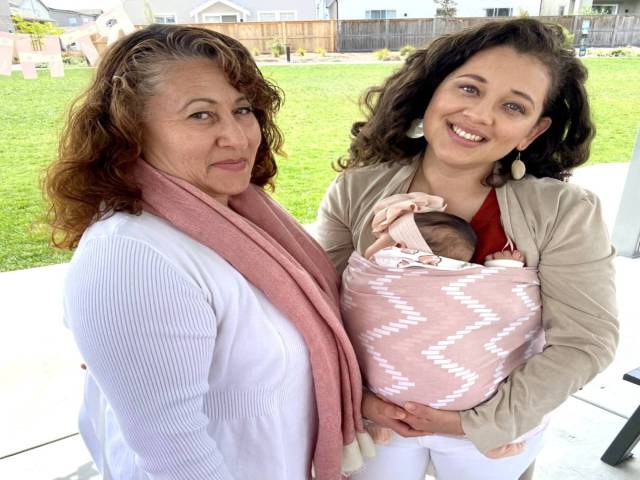
Diana Ortiz Giron with her mother and baby daughter.
X

For many, separation starts with the act of immigration itself, often forced by desperate circumstances. Diana Ortiz Giron, director of programming and education at Cal Poly San Luis Obispo, is the youngest of three siblings raised by a single mother who had to make a difficult choice: In 1996, she left her children with their aunt and grandmother and moved across the border, from Tijuana to Azusa, a city in Southern California, in search of economic opportunities.
“I remember very little from my time in Mexico, but what I do remember is people telling me that I would hold onto my mom’s leg when she would leave back to the States,” she says.
If families are reunited in the United States, even legal immigrants today face intensified fears of family separation, as Immigration and Customs Enforcement (ICE) detains more and more lawful residents with no criminal records.
Researchers note the phenomenon is not new. For decades, U.S. immigration policy has created conditions in which physical, emotional, or anticipatory separation is a recurring part of life for many Latino families—and increasingly, all immigrants today. The current enforcement landscape builds on that history, amplifying pressures that continue to shape health, decision-making, and family relationships.
Studies show that experiences with immigration enforcement, from racial profiling to knowing someone who has been deported, are linked to delays in healthcare—such as postponing doctor visits, avoiding hospitals, or forgoing preventive care—and increased psychological distress. Each additional encounter increases the likelihood that individuals will postpone care or report worse health outcomes.
Gustavo Carlo, a developmental psychologist at the University of California, Irvine, who studies Latino youth and family relationships, says the effects of enforcement-related separation can be especially damaging for children and adolescents.
“This form of forced separation is powerful and potentially destructive to health and well-being,” Carlo said. “It’s not only involuntary, but it often violates basic human rights. When it happens at a large scale, it intensifies fear, anxiety, and stress in ways that can disrupt the lives of children, families, and entire communities.”
Together, these findings suggest that today’s enforcement tactics do more than create isolated fear; they shape how people navigate everyday decisions about their health and well-being. According to advocates, today’s immigration policies reflect broader choices about who is protected in American society—consequences that reach far beyond migrant communities. But those communities are not helpless in the face of these forces. Families, advocates, and local organizations are working to buffer their impact and reimagine systems of support.
A long history of separation
Family separation in the United States dates back to the 18th century.
From the forced separation of enslaved families to exclusionary immigration laws that limited entry and family reunification, these practices have disrupted family networks across generations. Early federal policies, including the Alien and Sedition Acts of 1798 and the Chinese Exclusion Act of 1882, restricted migration and, in many cases, prevented families from remaining together or reuniting.
By the late 20th and early 21st centuries, immigration enforcement became more formalized through expanded detention systems and increased coordination between federal and local authorities. The creation of the Department of Homeland Security in 2002 reorganized immigration enforcement under a national security framework. Programs such as Secure Communities and 287(g) agreements enabled local law enforcement to work more closely with federal immigration agencies.
These changes broadened the scope of enforcement into routine settings. Encounters such as traffic stops or other local law enforcement interactions could lead to detention or deportation, increasing the risk of family separation beyond border crossings.
The Trump administration marked a significant increase in the scale and visibility of these practices. The 2018 Zero Tolerance Policy mandated criminal prosecution for unauthorized border crossings, resulting in the separation of thousands of children from their parents at the U.S.–Mexico border. At the same time, expanded interior enforcement, workplace raids, and efforts to rescind programs such as Deferred Action for Childhood Arrivals (DACA) contributed to increased uncertainty for mixed-status families.
In recent years, tens of thousands of spouses and children have been separated due to immigration enforcement actions. Many more families live with the possibility of separation, and some make difficult decisions about whether to remain together or apart in response to enforcement risks. Family separation continues to be a recurring outcome of immigration policy in the United States.
Anxiety and anticipatory grief
Today, Ortiz Giron is a newly naturalized U.S. citizen who was once undocumented and later became a DACA recipient. She says she constantly worries about what might happen if her husband, a brown Latino man, were to encounter ICE.
These fears shape even ordinary moments. “We have conversations about what would happen if we were detained,” she says. “The baby’s in the car seat, I’m in the back, he’s driving—and if they ask him to get out, we’ve already said: don’t intervene. Let them take you. I’ll find a lawyer. I’ll find resources to get you out.”
Psychologists and family researchers increasingly ask: What happens when family separation is to be expected?
To investigate, researchers distinguish between three interconnected experiences. Forced separation occurs when a parent is detained or deported. Separation by constrained choice happens when families preemptively separate in response to danger or instability. Fear of separation, often overlooked, describes the chronic anxiety of living under the constant threat that family unity could be shattered at any time.
These experiences do not occur in isolation; they accumulate and are increasingly shaping the psychological lives and cultural experiences of Latinos in the United States.
Ortiz Giron’s childhood experience reflects separation by constrained choice—one shaped by survival and economic necessity. While difficult, she says separations caused by deportation feel more like an unexpected death.
“You don’t expect it. You’re not prepared for it,” she says. “There’s grief and a loss of that connection to that family member, and there is deep pain throughout the whole process. I cannot imagine the fear that parents carry, knowing this could happen and that they could be separated from their children.”
Living with constant uncertainty
Maria-Elena De Trinidad Young is an immigrant health scholar who studies how immigration policy shapes family well-being. Her research shows that uncertainty itself can become a powerful force, influencing how people assess risk and make decisions about care.
“One of the big challenges that communities are facing at this time is having the ability to plan and make plans for their own future,” she explains. That uncertainty reaches into daily life, influencing whether parents seek medical care for their children or whether young people pursue higher education.

Maria-Elena De Trinidad Young, Associate Professor of Public Health, UC Merced.
Young emphasizes that this instability does not begin with high-profile enforcement actions. It’s built into the policy landscape.
“The baseline in this country…is one of exclusion,” she says. Federal and state policies often limit access to basic services such as healthcare, particularly for undocumented immigrants. Even before recent increases in enforcement, many families were already navigating a system where access to care, education, and work opportunities was uncertain.
That broader context matters. It means families are not just reacting to isolated events, but adapting to an environment where risk is constant.
Researchers have begun to describe this as more than a “chilling effect.” Rather than simply avoiding institutions out of fear, many immigrants experience repeated, direct contact with enforcement systems, from workplace raids to traffic stops or the detention of a family member. In some cases, a single deportation reverberates across an entire social network, affecting how neighbors, relatives, and friends assess risk.
Those encounters accumulate over time, shaping how people move through the world and how they make decisions about safety and health.
The psychological toll of separation on children
One longitudinal study followed more than 300 recently immigrated Latino adolescents in Los Angeles and Miami over the course of a year, surveying them at multiple points about their experiences of discrimination, depressive symptoms, and social behavior.
The researchers found that experiences of discrimination and chronic stress were linked to increases in depressive symptoms over the course of the year, which in turn were associated with lower engagement in helping and cooperative behaviors. Indeed, decades of research show that family separation is associated with increased anxiety, depression, and trauma, with effects that can persist into adulthood and shape educational attainment, social relationships, and long-term well-being.
In some communities, enforcement actions extend into spaces meant to provide stability, like schools and the courts. This disrupts school attendance, undermines feelings of safety, and disfigures the broader social fabric of schools and neighborhoods.
One reason family separation is so damaging is that it often creates what psychologists call ambiguous loss, a concept developed by family therapist Pauline Boss. She describes it as a uniquely stressful form of loss because it lacks clarity and closure, making it difficult for families to grieve or adapt.
Research on immigrant families has applied this framework to experiences of deportation and prolonged separation. Studies by Luis H. Zayas find that children in mixed-status households often experience persistent fear, anxiety, and disruptions to family roles when a parent is detained or deported.
As he explains in one paper, “The constant dread of the possible arrest, detention, and deportation of their parents sets the context that places citizen-children at risk for negative psychological effects and disruption of their developmental trajectories… [and] the actual arrest, detention, and deportation of parents serve only to complete the trauma.” This situation is shaped as much by uncertainty as by separation itself. In this context, a parent who has been deported may still be in contact, yet their absence remains unresolved and ongoing.
Ambiguous loss prevents closure. Families remain suspended between hope and grief, unsure whether reunification will ever occur. Over time, this unresolved stress can fracture family dynamics and isolate households from broader community support.
Exclusionary environments can intensify this isolation. Fear of immigration enforcement leads families to withdraw from social networks built through institutions such as schools and religious places of worship resulting in deepening loneliness and reinforcing vulnerability.
Familismo and the weight of separation
These effects extend beyond individual well-being. Gustavo Carlo points to the concept of familismo, which reflects the central role of family in many Latino children’s lives.
“Family is the training ground for children’s development,” he said. “It provides not just support, but shapes their sense of self and their sense of obligation to one another.”
These values can foster resilience, encouraging individuals to support one another even in the face of adversity. At the same time, they can heighten the emotional toll of separation, as disruptions to family unity strain entire support systems. This tension between resilience and strain defines many families’ experiences.
Carlo also emphasizes that these challenges do not define outcomes for all families.
“In spite of trauma and tremendous barriers, some individuals are able to overcome these risks,” he said. “There’s always the possibility not only to cope, but to contribute in positive ways, to support family members, strengthen communities, and advocate for future generations.”
In many immigrant communities facing the constant threat of deportation, separation is not an abstract possibility. It is a shared reality, an ongoing condition that shapes how families think about safety, belonging, and the future.
Supporting families and imagining humane enforcement
Despite the challenges of separation, Latino families and community organizations are finding ways to reduce harm and build resilience.
Legal aid, know‑your‑rights workshops, and case management help families stay together and access healthcare, education, and housing, while peer groups, faith communities, and culturally grounded Mental health services provide emotional support and reduce isolation.
Inside the home, families are also developing strategies to navigate the possibility of separation. A recent study by Mahsa Rafieifar and Hui Huang examines how undocumented parents talk with their children about legal status and the risk of family separation. The researchers found that these conversations are often carefully planned and emotionally complex, with parents weighing how much to disclose and how to protect their children from fear.
Some parents frame these discussions through stories of migration, explaining why they came to the United States and emphasizing hope and opportunity. Others make deliberate efforts to avoid being perceived as “lawbreakers” by reassuring their children that their actions are rooted in care for the family’s future. In many cases, conversations about legal status are intertwined with discussions about long-term goals, helping children make sense of uncertainty within a broader narrative of sacrifice and aspiration.
Some of the most difficult conversations center on contingency planning, particularly the possibility that a child may need to live with another caregiver. The study finds that while some parents identify trusted guardians and prepare their children for that possibility, others avoid the topic altogether, reflecting the emotional weight and uncertainty surrounding these decisions.
These strategies highlight the quiet, often invisible work families do to maintain stability under conditions of chronic risk. They also underscore the limits of what families can manage on their own.
At the community level, organizations like Freedom for Immigrants and UnidosUS advocate for policies that prioritize family unity, reduce deportations, and invest in community services rather than detention. Advocates and service providers increasingly emphasize that reducing harm requires not only individual Coping strategies, but systemic change.
How communities can buffer the effects
What would it take to ease the toll of family separation for families and the communities where it has become part of everyday life?
Researchers and practitioners point to a growing body of evidence showing that community-based support and policy changes can meaningfully buffer the effects of immigration enforcement on children and families.

Gustavo Carlo, Professor of Education, UC Irvine.
Studies in public health and social work have found that access to stable legal representation, community health services, and school-based support systems can reduce psychological distress and improve long-term outcomes for children in mixed-status families. Programs that provide universal legal representation, for example, are associated with higher case success rates and greater family stability, allowing parents to remain with their children and maintain access to work, housing, and care.
Mental health researchers also emphasize the importance of culturally responsive, family-centered care. Interventions that include peer support, trauma-informed therapy, and community-based counseling have been shown to reduce symptoms of anxiety and depression among children experiencing immigration-related stress. These approaches work in part because they rebuild trust and social connection, two factors that are often eroded in enforcement-heavy environments.
At the policy level, scholars argue that shifting away from detention-based systems is key. Community-based alternatives to detention, such as case-management programs, have been found to support high rates of compliance with immigration proceedings while allowing families to remain together. Limiting prolonged confinement and reducing the use of enforcement in sensitive spaces like schools and hospitals can also help restore a sense of safety in the institutions families rely on most.
Advocates, including organizations like Freedom for Immigrants and UnidosUS, argue that humane enforcement must center family unity and child well-being. That includes investments not only in legal systems but also in education, healthcare, and economic opportunity, factors that shape whether families can remain stable in the face of uncertainty.
Research suggests that the harms of separation are not inevitable. They are shaped and can be reduced by the systems surrounding families. With the right support in place, communities can buffer the effects of enforcement, protect children’s development, and create conditions in which families are able not only to endure but to thrive.
These policies could help make life better for all Americans. Maria-Elena De Trinidad Young emphasizes that immigration policy does not just affect immigrants.
“Even before 2025, in multiple studies I found that in states with many anti-immigrant policies, the health of U.S.-born citizens—regardless of whether they are white, Black, Latino, or Asian—is worse,” she says. “We need to understand that immigration policy is not just about immigrants; it reflects choices about how we treat people in society. Choosing to be anti-immigrant has implications for the well-being of everyone.”