


I love the idea of being a runner.
In 75 minutes a week, I can reap the benefits of listening to uplifting music, getting out in nature, and getting morning outdoor light, all while exercising my dogs and getting enough cardio to measurably improve my health, happiness, and longevity.
And at times in my life, I have been a real runner. I ran a marathon in my 20s and a couple of half-marathons in my 30s. In my 40s, I mostly just made spectacular plans every January and September: I’d find exciting destination races to train for, join a gym and a yoga studio, sign up for running challenges, and pick out elaborate training plans. I’d run three or four days a week for a week or two, and then nada. Zippo. Zero runs per week.
X
Then, in 2020, I got into a real running habit. I’ve told the longer version of this story on a TED stage, so I won’t repeat it here, but suffice it to say that I did it by doing very, very little running. When I started going to Orange Theory classes, I kept running. I sustained this exercise habit for six years, through breast cancer and many other difficult life events.
Then the Orange Theory studio down the street from me closed. I tried other studios, but the classes I like are impossible to get into.
So I embraced working out on my own and getting back to running outside with my dogs. I bought very heavy dumbbells and set up a home gym on our covered porch. I spent an inordinate amount of time choosing a destination race, enlisting my adult children to join me. I set up a training schedule on my Garmin watch, and when I didn’t stick to it, I used Nike Run Club. I made a running playlist. I bought a double running leash.
Friends, I have done four runs in three weeks.
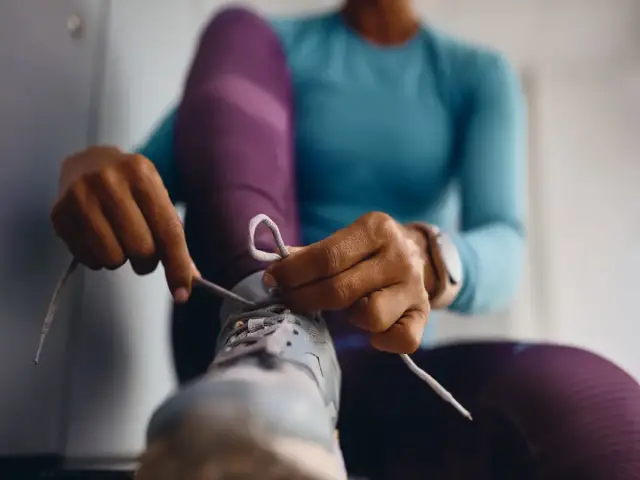
I know what I need to do. It’s so wildly unambitious that I’m embarrassed to tell you. I just need to get dressed to run first thing in the morning, put my dogs on their double leash, put on my playlist, and walk out the door, down the driveway, and to the mailbox. That’s it.
I know that most days, I’ll get a walk in, and once that walk is familiar, I’ll sometimes run a little. Some days I might run more, without even deciding to. But even when I don’t feel like doing more, the morning light I get while retrieving the mail and the walk back up our steep driveway are both good for me and genuinely enjoyable. It’s way better than nothing.
Ambition is the thing that fails us
The mistake I make again and again is assuming that the size of my plan and the odds of my success are related: the more inspiring the goal and the more elaborate the plan, the better my results will be.
Ambition and results are related, of course, but not in the direction you think.
Creating a habit takes energy and focus, and we’ve only got so much of either, which is why ambitious plans produce a brilliant week and then…nothing. It takes between 18 and 254 days for a behavior to become automatic, and what predicts faster adoption isn’t ambition, self-discipline, or willpower; it’s repetition.
The science of small
Repetition in a consistent context drives habit formation. Not just effort, intensity, or how badly someone wants it. Doing the thing, in the same place at about the same time, again and again, has the most impact.
Success is motivating. Doing what you said you’d do, even something absurdly small, builds the belief that you can do it. Failing repeatedly does the opposite; that’s a big part of why I spent my 40s making elaborate plans but not running.
Small behaviors make repetition more likely. What separates an actual habit from a nice couple of weeks is whether it holds up when you’re stressed, tired, busy, or not feeling 100%.
Missing a single day doesn’t meaningfully set most people back. We don’t need to be perfect here, folks. What won’t survive is a plan so ambitious that the off days outnumber the on days.
Micropractices, as researcher Eli Susman calls them, are very small behaviors that also have their own benefits; a tiny practice isn’t just a placeholder for a “real” one. Susman found that 20 seconds of self-compassionate touch (for example, sending kindness to yourself while placing your hand on your heart) per day improved Mental health and lowered stress compared with a placebo finger tapping practice.
Across 280,000 meditation sessions in 103 countries, how consistently people meditated predicted their mood and resilience better than how long they sat. Similarly, a meta-analysis combining the results of many studies found that the benefits of practicing breathwork for stress didn’t depend on how long the session were. And breaking up six hours of sitting with brief bouts of walking improves energy, mood, and food cravings more than doing 30 minutes of walking all at once.
In short: How often beats how long.
I hate the idea of abandoning my big plans. But the truth is that I am not choosing between the ambitious version and the tiny version. I am choosing between the tiny version and nothing.
How to build your better-than-nothing plan
Break the core behavior central to your habit down into something you can do in under five minutes, start to finish. Under a minute is even better. This isn’t the version that would impress your doctor or your neighbors; it’s the version you can do while exhausted, while traveling, while a little bit sick, and when you want nothing more than to stay on the couch.
Then, check it for resistance. If you feel any reluctance when you imagine doing it, it isn’t small enough yet. Cut it in half. Most people need to start with a micropractice: putting on your walking shoes and stepping out the front door, doing one pushup or 30 seconds of breathing, eating a single leaf of romaine, which, for the record, contains actual fiber and actual nutrients.
Do just that for a while. Resist the urge to do more. This is hard, but the moment you’re no longer willing to be unambitious is the moment you put the whole thing at risk. That’s when difficulty enters, and negotiation with yourself, and the possibility of failure. Your tiny habit doesn’t depend on motivation, which is precisely what makes it survive the days when you have none.
Expand only when you’re itching to, and only in absurdly small increments. Go one more minute, not 10.
What you’re actually building
Every time you repeat a behavior, your brain physically strengthens the connections that produce it, the way feet crossing a meadow gradually wear a path. Repeat it enough and the path becomes a groove your brain follows on its own, no willpower required. You’re carving a neural pathway for your habit, and everything you want is downstream from that.
At some point, it will become uncomfortable not to do this new behavior. You’ll do it without deciding to, without trying to. That’s the whole goal: repetition until the thing runs itself.
It’s hard to abandon our grand plans and great ambitions for something embarrassingly small. But, paradoxically, it is only in that tiny step that some of our grand plans are truly born.