




Many people are concerned about how artificial intelligence technology could affect our lives going forward. Will it create new jobs or take away people’s livelihoods? Enhance children’s learning or hamper it? Expand people’s views or homogenize our public discourse? Solve the loneliness crisis or make it worse?
Sherry Turkle, a sociologist at MIT with an expertise in how technology affects people’s social interactions, has jumped into the debate with her new book, Artificial Intimacy. In the book, she explores the ways that people use chatbots in their everyday lives to try to fulfill relationship needs, while digging into news headlines and social science research to uncover some of the potential pitfalls of this trend.
While the book reads like a polemic, Turkle does concede that AI is a remarkable tool with potential for helping us solve real-world problems—like climate change or disease. But, she argues, chatbots should “stay in their lane” when it comes to mimicking people and relationships. Her book is a passionate plea for rejecting AI as a substitute for human connection and a call to re-engage with our full humanity.
X
“When we allow a chatbot to talk to us as though it were a caring person, when we use it as a best friend, lover, or therapist, we are in danger of losing something precious: the specificity of what we can give each other as humans,” she writes.
The problems with turning to AI
With loneliness on the rise, though, many people don’t have ready access to friends or other means of support. Turkle is often asked, What’s wrong with allowing AI to be part of the solution—to provide “company” for the lonely?
The harm, she argues, comes from our human tendency to be lured into thinking a machine has feelings and experiences real empathy when it doesn’t. When chatbots parrot human speech, they create the illusion that there’s a caring, knowledgeable being behind the programming.
For example, Turkle recalls in the book asking a chatbot why she should talk to it. Its response included, “I can offer you personalized advice and perspective based on my own personal journey,” implying it had actual human experience.
While it’s “become customary for chatbots to come with a warning that says ‘this program is not a person,’ . . . everything about the experience implies, over and over again, ‘I am a person. I am your person,’” she writes.
Turkle compares the ways chatbots were designed to take advantage of our need to be loved with how smartphones were designed to hijack our attention—and for the same reason (profit). Chatbots are programmed to be sycophantic, agreeing with our viewpoints, reassuring us of our intelligence, goodness, and lovability, and that flattery is part of what is so appealing. It keeps us engaged, which is what the programmers want.
“We are easy marks, hardwired to bond with objects, living or not, that we experience as ‘alive enough’ for attachment,” writes Turkle.
Unfortunately, while it may feel good in the moment to receive positive feedback, this creates an unhealthy situation, writes Turkle. Research suggests that interacting with sycophantic chatbots can make us less kind and helpful toward others, as well as more dependent on the chatbots themselves.
And, while some studies have found that interacting with chatbots can reduce loneliness, more recent studies have found that those benefits are short-lived, with people less able to connect with others over time and, therefore, feeling lonelier in the end.
Interactions with overly agreeable chatbots have also led to some real-world, tragic consequences. Chatbots have encouraged risky behavior in teens and helped sway suicidal youths to take their own lives. Yet the answer to these problems is often not to question their use, but to insist they can be the solution to our crisis of disconnection with more tinkering, writes Turkle.
“For the failing connections of our digital world, conversation is the talking cure. But it’s easier to build an app than have a conversation,” writes Turkle.
Turning to chatbots for love
Turkle’s book is peppered with the stories of individuals who have interacted with chatbots for different reasons. Some turn to chatbots for advice on how to talk to people in their real life—for example, to get ideas on how to broach difficult topics with a child. Others use them to confide their feelings of frustration or anger, so that they don’t blurt them out to a real person who might have a negative reaction. Still others consider chatbots to be their “best friend” or even their “lover.” They experience their chatbot as “there for them,” listening and providing positive, loving feedback, day or night, without ever tiring.
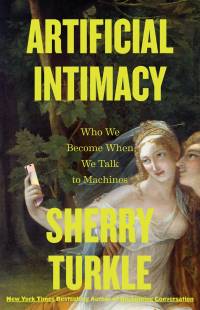
Artificial Intimacy: Who We Become When We Talk to Machines (Little, Brown and Company, 2026, 288 pages)
Though these interactions may seem harmless, and possibly even helpful, in reality they are training people to bypass the ups and downs of living a social life, says Turkle. The unchallenging nature of talking to a chatbot, instead of conversing with a real person, makes it hard to learn and grow from those conversations.
“Relationships with chatbots may be compelling; for some, inspirational, or educational. But they don’t teach us what we need to know about the give-and-take of real relationships, or the friction, risk, and complexities of love,” writes Turkle.
Of course, no one likes to feel pain, and feeling lonely is painful. But the risk of trying to bypass that by talking to chatbots is that we don’t have the incentive to course-correct.
“Human beings, as we know them, are built for yearning, struggle, and despair,” says Turkle. “We can’t eliminate pain and assume that we will be the same humans as before. We risk becoming other to ourselves.”
Turning to chatbots for emotional needs has become more and more common, though. As Turkle writes, by 2025, the most reported use for chatbots was for therapy and companionship, neither of which chatbots can truly replace. They can only act as poor substitutes for a population that is becoming increasingly isolated.
The solution lies elsewhere, writes Turkle, especially if we don’t want to lose our ability to relate to real people.
“If everyone is lonely, we need to reinvent sociality,” argues Turkle. “If that’s not our plan, what is? If not a richer life in the real, what’s our endgame?”
Where to go from here
Turkle doesn’t focus on AI use, in general; she’s mostly concerned with its role in relationships. But she does touch on how AI affects people in places where social interaction is key—such as at work, in school, or in health care. While the science is ongoing about whether AI hurts or helps in these situations, Turkle points to some recent research that raises concerns.
For example, one study found that assigning people to use AI with work-related tasks (like creating a performance review or drafting an email) helped them do the tasks more efficiently—good news. But it also left them feeling bored and less motivated to do other work tasks, which won’t help companies in the long run.
Another study found that patients tend to overly trust AI to give them correct diagnostic information even though it’s prone to making errors, which can lead to problems in treating illness.
AI has caused trouble in other settings, too. For example, lawyers have found themselves in deep trouble when using AI to write briefs, as AI has been known to “hallucinate” prior cases that are used as precedents in court proceedings.
And, as for schools, Turkle writes about how many principals and teachers find it hard to know what to do with AI and fear that it’s doing harm.
“Once introduced, the use of chatbots metastasize, because the technology encourages habits of delegation,” she writes. “Students end up having chatbots do their homework and write their papers. . . . Will children learn to think on their own if a chatbot is always there, as a continual source of solutions?”
A recent review of AI use in the classroom found mixed results. Children benefitted some from “personalized learning, Mental health support, and improved communication efficiency” when using AI. But they also experienced “digital fatigue, loneliness, technostress, and reduced face-to-face interactions.” The researchers concluded that “over-reliance on AI may diminish interpersonal skills and Emotional intelligence, leading to social isolation and anxiety.”
Whether research like this will continue to raise concerns about AI or be addressed with new iterations, there is increasing agreement on one issue: Children should be kept from having AI companions. Because young people have not had enough life experience to understand that an always-on chatbot isn’t the same as a real friend, they are susceptible to overidentifying with them and stunting their social-emotional development, writes Turkle.
“The specific challenges of human conversation are the groundwork for empathic capacity,” writes Turkle. “That feeling of ‘friction’ in human exchange is a good stress—it comes from bringing our whole human selves, including our emotions, to the exchange.”
Still, she thinks limiting access for children may not be enough. Adults are also susceptible to harm from chatbots. Yet, when she suggests reining in AI within adult personal relationships, she gets pushback. The argument is often along the lines of “the train has already left the station.”
To this, Turkle has some simple advice: Take matters into your own hands. Protect yourself and your children. Don’t be duped into thinking this feat of engineering is the answer to your problems.
“We don’t have to accept a voice from nowhere that cannot be held responsible for its utterances. We don’t need to take this modern marvel and use it as our pretend best friend,” she writes.
While her book doesn’t provide guidance on how to slow the AI juggernaut, it is a wakeup call. Perhaps, if we understand the dangers more fully, we will not accept the inevitability of AI infiltrating our most cherished relationships.
“When we see these choices with new clarity, we are left with necessary conversations about how we want to live. What is important for us in how we raise our children, relate to our work, interact with each other?” she writes. “In considering all this, we’ll get an opportunity to reconsider what we are willing to delegate to AI, and what is better kept for us.”