





Artificial intelligence can summarize research, generate ideas, and analyze enormous amounts of data in seconds. The power of that little “Ask anything” AI prompt box is immense, but can it help us make wiser decisions? Cheryl Strauss Einhorn, author of The Human Edge: Smarter Decisions in the Age of AI, writes:
AI has the power to enhance decision-making—or to overwhelm it. It can illuminate pathways we might not have seen or narrow our choices in ways we do not fully recognize. As AI systems become more integrated into our lives, the challenge is no longer simply about harnessing their power but about leading them with clarity, discernment, and commitment to human agency.
She argues that the rise of AI actually makes certain human qualities like reflection, empathy, values, and moral judgment even more important. We spoke with her about why human judgment is a competitive advantage, how to engage our values when we prompt AI, and how AI can help us clarify our thinking.
X
Kia Afcari: You argue that AI makes human judgment more, not less, important. How can we make sure that the values of kindness and care are reflected when we use AI to help us make decisions?
Cheryl Strauss Einhorn: AI has no values. It has biases and influences by those who have designed it, and from whatever information has been fed into it. So to be sure that prosocial values are reflected when we use AI, we humans need to bring them into the work that we do together.
When working with an AI tool, we want to be asking ourselves, What is the problem that I’m solving? Why am I solving it? What is the context? And so we really need to be intentional with AI, because without asking ourselves those things first, AI doesn’t know why we’re coming to it.
Before you actually sit down with a tool, you can muster those values and those important factors related to the problem that you’re solving, and then articulate them and communicate them to the machine.
If we let the machine think for us, we can lose that sense of right and wrong, for example, because we actually care about all of those details that AI can’t possibly know about the problems that we’re solving and the people that we’re solving those problems with and for.
For example, you might ask yourself or your AI tool: Before I act, help me think through the people, relationships, and responsibilities this decision affects—not just the outcome it produces.
This type of human-centric AI interaction helped Felice, a food scientist at a pet food company, who was responsible for developing new recipes that balance nutrition, taste, and market trends. She often has to delegate tasks within her research team, ensuring that product testing, ingredient sourcing, and regulatory compliance all move forward smoothly. Using AI, she was able to analyze workloads and expertise that suggested the best person for each task, but only Felice understood the deeper dynamics at play—who works best under tight deadlines, who has a passion for innovative formulations, and who needs mentorship. When AI recommended assigning a crucial stability test to her most experienced technician, this prompt supported her thinking about a different option: giving it to the junior scientist who was eager to develop his skills in quality assurance. The AI tool’s choices made sense based on efficiency, but Felice’s decision ensured both short-term success and long-term team development.
KA: In the book, your “cheetah” metaphor celebrates slowing down. Why is a strategic pause so important when working with AI?
CSE: The cheetah metaphor relates that although this is an animal that goes zero to 60 in about three seconds, its hunting prowess actually comes from being able to decelerate up to nine miles an hour in a single stride. And the reason why that’s so important in problem solving and decision making is that’s where you build agility, flexibility, and maneuverability. Do I want to stay the course, or do I want to pivot and do something else?
This pause allows you to chunk your learning and pry open that cognitive space for new information and insight. With an AI tool, it’s so important because there’s a difference between speed and quality.
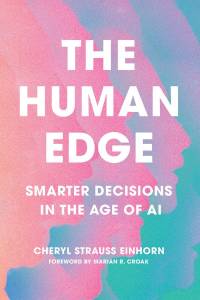
The Human Edge: Smarter Decisions in the Age of AI (Cornell Publishing, 2026, 180 pages)
When something truly matters to us, we want to make sure that we’re solving the problem in a way that solves it holistically, that takes care of the people who are involved in the problem with us. And when we’re moving really quickly, sometimes those very important factors are hard to bring forward. So there’s a real difference between what is efficient and what is effective.
KA: Why can having more information make it harder—not easier—to make good decisions?
CSE: Francis Bacon once said, “Knowledge is power,” but that’s not really true anymore, right? We now have all of the answers with AI to a lot of commonly asked questions and some uncommon questions.
We need to make sure we’re defining the problem that we’re solving, that we are understanding and communicating the motivation and providing the context, because you don’t want all the information. Otherwise, we’re going to end up with analysis paralysis.
One thing people can use is what I call the “vision of success” question. This question asks you to time travel, to jump over the decision to see that the decision has been made well. What’s happening? What are those few things that if they don’t succeed, the decision fails? It’s actually very powerful, because it allows you to clearly identify so that you can articulate those factors that you absolutely need to be able to share with AI. These become the constraints and boundaries that set the perimeter around the decision, so that it can give you research that’s targeted and focused on those things.
For example, Max deciding where to spend his next vacation. Asking AI for
help directly—without turning to himself first—he got a list of destinations, airline options, and local attractions, complete with ratings, reviews, and price comparisons. On paper, that sounds ideal. But in reality, Max quickly found himself paralyzed by the sheer amount of information. What if he picked a less-than-perfect hotel? What if he overlooked a hidden gem? AI has handed him a mountain of data, but it didn’t necessarily make the decision any easier.
However, when he used the “vision of success” question, he was able to realize and to share with his AI tool: “I want to return home feeling genuinely rested, having spent quality time with my family, without overspending or feeling like I missed the experience I was hoping for.”
Only then does AI have a meaningful problem to solve. Instead of searching for the “best” vacation—a question with no objective answer—it can help Max find the destination most likely to produce the outcome he actually wants. AI can’t define success but it can optimize for the success you define.
KA: How does the AREA method help people make wiser decisions, especially when AI is involved?
CSE: AREA is more than an acronym—it’s a framework for challenging our assumptions and thinking mistakes, and actively includes the perspectives of others. It stands for Absolute, Relative, Exploration and Exploitation, and Analysis.
The first “A,” Absolute, focuses on primary, unfiltered information straight from primary sources. “R,” Relative, shifts to external viewpoints—secondary sources connected to the subject. “E,” Exploration and Exploitation, fuels creativity: Exploration broadens research through interviews and unconventional sources, while Exploitation turns inward, challenging personal biases and assumptions. The final “A,” Analysis, synthesizes everything, bringing clarity and structure to complex decisions.
When using AI, a system like AREA becomes even more important because AI doesn’t eliminate bias—it can reflect and sometimes amplify biases in its training data, design, and the way we use it. Good decisions require a process that helps us recognize and challenge both AI’s biases and our own.
For AI, so much of the information, for example, is from Reddit. Information can be incomplete or outdated, and you also know that you’re interacting with a liar. It’s a machine that just gives you answers that are wrong sometimes.
So you need to be able to have a quality due diligence process to not only be able to use the tool effectively, but to be able to evaluate its outcome. Too often, people look at an answer with AI and think that it’s a transaction, and they can just take it. AREA is going to help you make sure that it’s a conversation. So you have an evidence-based perspective that has looked at a variety of stakeholder viewpoints, and made sure that you have pried open that cognitive space to challenge the natural, well-worn mental pathways that we all lean on every day.
KA: How can we use AI in ways that strengthen—rather than undermine—our values and agency?
CSE: It’s a great question. I think the new competitive advantage is going to be Self-awareness.
This is the first tool that actually asks for some of our cognitive load; it wants us to offload some of our decisions to it. And this is a machine fundamentally about decision making, because we ask it for something and it gives us an answer. But there’s a very interesting invitation here, which is to each of us to get to know ourselves better.
We each have a special sauce, which is the way that we make our decisions, and we make thousands of them every single day. But most of us have not sat down and said to themselves, What does that process actually look like? Can I actually name those pieces and put language to it?
There is this invitation to get to know our thinking so that we can translate it better, and not only for the tool. How helpful would it be in conversation with our colleagues to be able to say clearly, This is how I’m actually going through the steps, this is how I’m thinking about it, these are the variables that I’m prioritizing, and here’s what I think is the most diagnostic.
You can think about your thinking skills as muscles. If we turn over our cognitive load, we will also weaken it. But if we actually take this invitation to understand our Self-awareness and our metacognition, we can make sure that we strengthen those tools.
AI is a tool that has so many implications for our environment and for our world, in addition to the fact that it has implications for our actual thinking skills.
So I would say that the invitation is to turn to yourself first. Ask yourself why you’re using the tool, and whether or not you should be turning to yourself instead. And either way, bring your own thinking forward before sitting down, so that you can feel far more comfortable that you can problem-solve both with it and beyond it.