




What does it mean to raise a resilient child?
Resilience is a skill set that combines emotional awareness, problem solving, and flexibility—qualities that help kids bounce back from stress and adapt to adversity. Parents can help cultivate it by equipping kids with tools to navigate hardships so they feel more confident, courageous, and capable.
Whether it’s helping your child handle disappointment, temper big emotions, or tackle something scary, opportunities to teach kids resilience arise every day.
X
Despite these growth-building opportunities, many kids are facing what psychotherapists and parenting experts Sissy Goff and David Thomas call a “crisis of capability.”
In their new book, Capable, Goff and Thomas draw on 30 years of clinical experience, providing a roadmap to help parents raise kids who stay steady in the face of struggle, believe in themselves, and take on healthy risks that stretch their abilities.
Juli Fraga: What inspired you to write this book, and why is it important now?

David Thomas, LMSW
David Thomas: Youth Mental health has been a crisis for several years. We’re seeing one in five kids dealing with anxiety, and 18% of kids between the ages of 12 and 17 dealing with symptoms of depression.
In our work, we’ve seen that this decline in Mental health has been followed by a decline in kids’ capability. Now more than ever, our offices are filled with kids who feel incapable of doing things like reaching out to a new friend, trying out for a sport they might not do perfectly, or getting their driver’s license.
JF: I’m curious what role anxiety plays in shaping a child’s confidence. Can you share more?

Sissy Goff, M.Ed., LPC-MHSP
Sissy Goff: When it comes to anxiety, research shows that two common parenting strategies are escape and avoidance. So, when a child feels anxious, we’re seeing more parents pull their kids out of scary situations than we ever did before.
I have written several books on anxiety, and the layperson’s definition that I came up with is that anxiety is an overestimation of the problem and an underestimation of what kids can do themselves. And so, when we rescue a child, we may send the message that kids need parents to always step in and that they can’t do hard things on their own.
JF: What does it mean to be a capable kid?
DT: Capable kids have practiced coping and developed competence to face life’s challenges. And here’s one thing we challenge parents to consider: Stress is guaranteed. No one is exempt. But here’s one thing we tend to forget: Stress can also be growth-giving. So, if we can camp out in that space and remember that when our kids experience stress, good growth can happen.
For example, my daughter tried out for cross-country in middle school, and she came in dead last for over three seasons. And so much growth happened in that season of her life. I just cheered her on as she finished a marathon. That milestone would have never happened if she hadn’t spent a lot of time running and coming in last.
To raise capable kids, we want to support them without standing in the way of growth-giving opportunities. This sends the message that competence is deeper than confidence. We put a lot of focus on praising kids and raising confident kids, which, of course, we all want. But we really believe that confidence is born of competence, and this is what happens when kids struggle with something hard and develop the skills to handle it.
JF: Research shows that flexibility and resilience can be learned. What are some small things parents can do to help their kids practice these skills?
DT: Remember that you are your kid’s hero. Even if they’re adolescents and rolling their eyes, kids hear what you say and see what you do. Practice flexibility together as a family, and let your kids know how challenging it can be for you, too.
For example, you might start every night at the dinner table by having each person move one seat to the left. Model what it’s like to mix it up. Send the beautiful lesson that you’re all figuring it out as you go.
JF: In this era of information overload and AI chatbots, what advice do you have for parents who may feel unsure about what advice to listen to?
SG: There’s so much information out there, and we find that parents are trusting experts more than they’re trusting themselves. Parents may ask AI how to troubleshoot a problem, and while AI provides information, it’s certainly not wisdom.
We advise finding two to three sources that really help parents to trust their gut.
JF: If a parent is reading your book and they want to learn skills to help build their child’s resilience, what can they do?
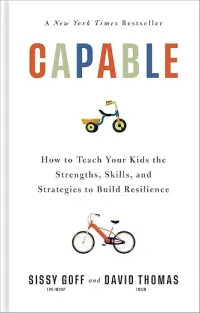
Capable: How to Teach Your Kids the Strengths, Skills, and Strategies to Build Resilience (Bethany House Publishers, 2026, 224 pages)
DT: In the book, there are five strengths, five skills, and five strategies that we believe are foundational to building capable kids.
One skill is dealing with disappointment and failure. We challenge parents to remind their kids that failure is the gateway to neuroplasticity—our brains literally grow when we fail. We love the acronym FAIL, which is a “first attempt in learning.” As parents, let’s flip failure on its head and see it as a tool for growth.
We also encourage parents to narrate the experience as they go. Talk about mess-up moments that have happened to you.
For example, I had a wonderful and funny conversation with a mom who decided to take up tennis in her 40s. She said to me, “David, I never played the sport growing up. Turns out, I am terrible at it. The instructor gave me some feedback in front of the entire class, and I found myself tearing up. But then I thought, This isn’t Wimbledon; this is mom tennis!”
This turned out to be a beautiful opportunity for this mom to talk with her kids. She shared what it felt like to have a coach give her feedback in front of others.
There’s incredible value in sharing our experiences with our kids. It shows that we are going to fail at different things, we aren’t going to have everything figured out, and we are going to feel overwhelmed.
I think these conversations have a lot of value.