



I sat around a table with a group of fourth graders learning to be mentors for younger students, and a girl looked at me and said, “Now whenever I am upset, I have Buddy and Snuggles in my head.”
Buddy the dog and Snuggles the bunny are two of the five resilience habit animals that children at a Milwaukee school are learning to help themselves thrive. Buddy reminds kids they are not alone, and Snuggles represents kindness.
A violence prevention grant brought me into kindergarten through third-grade classrooms in early 2025 to help children use mindfulness and Self-compassion practices to self-regulate, and we just wrapped up our time together. In my work as a teacher, I found myself learning just as much from them as they did from me about how these skills take root.
X
If you are a parent, teacher, or clinician, you might wonder how to translate abstract concepts like mindfulness and Self-compassion into something a seven year old can actually use. Over a decade of teaching these skills in classrooms and with families, I’ve found that playful animal characters, when practiced in relationship, can become a voice children can carry inside to help them face hard moments with kindness.
Identifying your animal character
When I teach a lesson, I observe what causes children to lean in, and what makes them push back or disengage. One major thing I’ve observed is that kids love learning from animal characters and other kids. A group of children helped me create the Self-compassion-workbook-for-kids/” title=””>Mindfulness and Self-compassion Workbook for Kids, which features animal characters and real kids sharing their experiences throughout the two-volume series. Children also taught me that they enjoy activities that are playful and authentic.
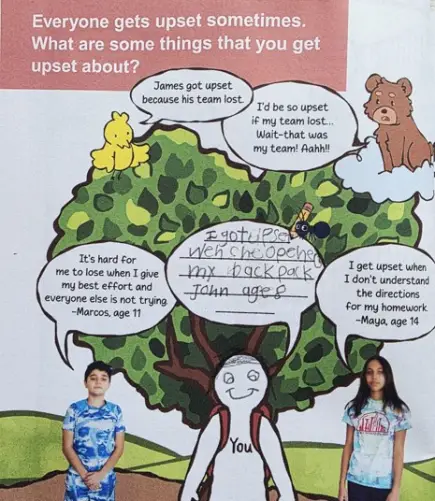
Worksheet from the workbook
This has been true across different contexts, including the Milwaukee school I’m working in, where 97% of students live in poverty and 1 in 5 have a special education plan. In my first year in the school, there was a large second-grade classroom that had a lot of self-regulation challenges and diverse reading abilities. Nonetheless, when I shared images from the workbook of animals or real kids talking about their feelings, students’ hands would soar in the air to read their quotes and share their own experiences on the interactive whiteboard.
We started our lessons each school year with an animal quiz. Our first year, kids did the Feelings Habit Animal quiz to uncover their habits around feelings. During our lesson time together, kids learn about five different patterns: Bear explodes with feelings, Beaver obsesses about feelings, Chameleon hides feelings, Deer feels ashamed of feelings, and Flame the dragon has a mix of these habits. The feelings habit animals offer children the opportunity to observe their patterns around feelings without judgment.
Sometimes at the beginning of a lesson, we play games of charades to playfully act out the animal habits. Kids feel affection toward the feelings animals, and they also know that each animal represents feelings habits of themselves and their classmates. Observing their own behaviors through an animal lens provides cognitive distance that can pave the way for wiser choices over time.
Once children have a way to notice what they are experiencing, the next step is learning how to respond. Our second year, students took the Resilience Habit Animal quiz to identify the animal habits that felt helpful when they struggle. Kristin Neff describes Self-compassion as having three core components: mindfulness, common humanity, and self-kindness. In my work with kids, these components come to life through three resilience habit animals: Spots the giraffe helps kids notice their feelings, body sensations, and five senses; Buddy the dog reminds kids they are not alone; and Snuggles the bunny represents kindness.
Play is the language of children, and this is especially true for Self-compassion. While kids are generally uninterested in practicing Self-compassion when it’s called Self-compassion, they are often eager to try the “Spots habit” or the “Buddy habit.” Not only are kids more engaged in the practices, but some kids report imagining the animals’ voices in their minds when they are struggling. This is true both in the classrooms I teach in as well as in research on the Self-compassion-class/” title=””>Mindfulness and Self-compassion for Children and Caregivers program, which I developed as an adaptation of Neff and Christopher Germer’s Self-compassion.org/the-program/” title=””>Mindful Self-compassion program.
Each year, I saw students eagerly engage with the quiz to find out which animals they had an affinity toward. Once they did, they felt more curious about the animals’ habits, and especially connected to “their” animals. While I didn’t know it at the time, there’s research that suggests that using animals to teach children can help them acquire social-emotional skills at an early age.
Animal stories, role plays, and songs
Modeling and practice between sessions are essential for building these habits, but without time for educator training, I had to get creative about helping kids practice more during our time together. I partnered with Brienne Barrows-Gallardo, a gifted early education teacher who works with preschoolers with autism, to help me develop engaging materials kids could use to practice.
We wrote a story for each resilience habit animal so kids could see the helpful habits in action. Then my own children helped me create story videos and songs, which aided kids in internalizing the resilience animals’ voices. I also made role-play kits with different phrases each animal could say.
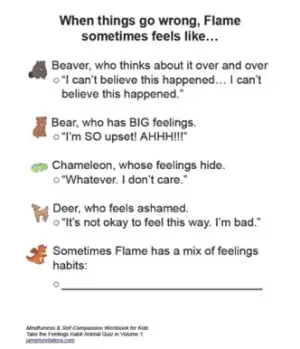
Quiz question
For example, in one story, Flame the dragon was feeling upset, and Buddy reminded her that everyone feels upset sometimes. Because Flame can have multiple feelings habits, kids were able to choose how she responded using the choices in the role-play kit.
The children also had a picture of Buddy the dog to decorate or color, along with phrases that Buddy might say to soothe them.
As kids colored, the classroom teacher and I moved about the room engaging in role plays with them. One of my favorite moments was hearing the teacher pretend to be Flame with big Bear feelings, and a kindergartner responded, “Ms. B., it’s OK to feel like this. Everyone gets upset sometimes.”
Another week, after talking about how Bear has big feelings, the kids and I did a group role play on the carpet helping Bear with the Snuggles habit. Then the kids had the opportunity to decorate Snuggles the bunny while we rotated around to practice. A child who often has big feelings didn’t like how she was coloring her page, so she ripped her paper in half and threw it on the floor. I walked over to her desk, and acknowledged that she was having big feelings. She looked up at me, and her eyes flashed with recognition. She was having the Bear habit! Instead of spiraling, as she often does, she picked up her paper, and we taped it back together. This is the power of awareness.
The feelings habit animals not only help kids with awareness (the Spots habit), they also help kids to feel less alone with big feelings. Kids know that other kids share their feelings habits, and, in this way, common humanity (the Buddy habit) is linked with the animal.
Barrows-Gallardo also created social stories that could be used with the children with autism in her classroom. Research suggests that using animal characters can help children on the autism spectrum learn social-emotional skills. In the classrooms, I noticed that a number of neurodivergent children were highly engaged in learning about the resilience and feelings habit animals. One child astutely observed that we didn’t need to practice the feelings animal habits because they are already “built in.”
Children also loved embodying the action-oriented resilience animals, like Super Snuggles and Doodles the dolphin. Doodles encourages kids to take helpful actions like moving their body and trying their best.
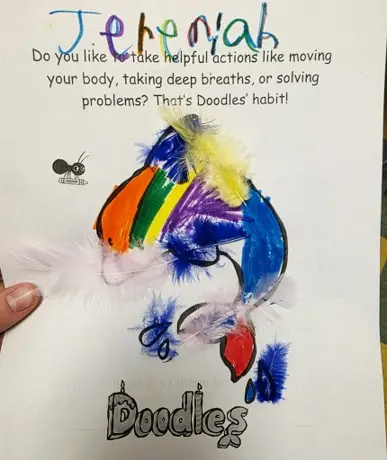
Art page
When they step into these animal roles, children aren’t just learning the habits; they are becoming them. Research has found a similar effect: When children imagine themselves as strong or capable characters like Batman, they are more likely to persist through challenges.
One parent whose son did the Mindfulness and Self-compassion Workbook for Kids told me that her son, who also had the Bear habit, had to do vision therapy. He had a little stuffed bear that represented the bear from the workbook that had big feelings. When he felt frustrated with his vision therapy, he would look at his bear, and it would comfort him. For him, seeing his bear feelings animal helped him remember “I am not alone” and “I can handle this.”
The role of the caregiver
As beautiful as it is to see children practicing Self-compassion with the animal characters, I know it’s not enough for the practice to fully take root. The work we started through the violence prevention grant will only go deeper if the teachers understand, practice, and reinforce Self-compassion next school year. The principal of the school and I are trying to arrange inservices for the teachers next year to help them grow their own Self-compassion practice and support students with continued practice. This is because my relational Self-compassion/” title=””>four-step framework for helping kids grow Self-compassion begins with the caregiver.
As parents, teachers, and caregivers, the best place to begin is with our own mindfulness and Self-compassion practice. We can do this alongside a child, or on our own. When we model being mindful of struggles, it helps kids remember that everyone struggles sometimes. And when we model self-kindness, it helps kids learn to do the same. Children learn from watching us say, “I feel upset, and I know that everyone gets upset sometimes. I’m going to be OK.”
Kids also internalize how caregivers speak to them. We want to be the voices of Buddy and Snuggles, reminding kids, “You’re not alone. I care about you.” There are many ways to help kids grow Self-compassion in daily life, and our presence is just as important as our words.
Self-compassion takes root through supportive relationships and playful animals that bring it to life. From Sesame Street to Daniel Tiger to Mister Rogers’ Neighborhood, children have always learned emotional skills through the characters they love. Over time, these characters can become something even more powerful: a compassionate inner voice that children carry with them for life.